Guide · from the data
How to get better at chess.
Most advice on improving is a list of everything: tactics, openings, endgames, longer games. We counted instead. In 5,718 rated games, each checked move by move by a chess engine, we found the move that lost every lost game and sorted it by what went wrong. The list is short, the order changes with your rating, and it says what to fix first.
Numbers from 11,436 player-games, Lichess blitz and rapid, October 2026
What actually loses chess games
Every lost game has one move that cost the most winning chance: 40 points on average, the difference between a game you could hold and one you couldn't. Across 5,364 lost games, that move left something to be taken for nothing in 27% of them and walked into the opponent's threat (a fork, a pin, a mate threat, a loose pawn) in 27%. It allowed a mate in 7%, passed up a win that was on the board in 13%, and was a judgment call, with no material changing hands, in 10%.
So getting better at chess is, for most players, not a matter of knowing more. The games are lost one move at a time, with time on the clock, from positions that were fine. That is good news: a habit is quicker to fix than a gap in knowledge.
| Rating | Lost to a hung piece or a missed threat | Lost games that had been winning | Blunders a game | Blunders with under 30 seconds left |
|---|---|---|---|---|
| 400 | 39% | 34% | 3.1 | 4% |
| 600 | 44% | 36% | 2.9 | 5% |
| 800 | 46% | 36% | 2.7 | 7% |
| 1000 | 57% | 38% | 2.6 | 5% |
| 1200 | 54% | 40% | 2.5 | 8% |
| 1400 | 61% | 38% | 2.3 | 8% |
| 1600 | 61% | 31% | 2.3 | 10% |
| 1800 | 56% | 33% | 2.1 | 13% |
| 2000 | 60% | 32% | 2.0 | 17% |
| 2200 | 58% | 24% | 1.6 | 23% |
| 2400+ | 58% | 20% | 1.2 | 34% |
Rated Lichess blitz and rapid, player's own moves after move 10. The first two columns are shares of lost games.
The five habits, in the order to fix them
The order is by how many games each one decides and how cheap it is to fix. The first two are one question each, asked before every move.
1. Stop giving pieces away.
A piece left to be taken decides 27% of losses, and between 26% and 32% at every rating up to 1800. 80% of hung pieces were taken on the very next move, and 84% were played with more than a minute on the clock. The check: before you let go of the piece, look at the square it lands on and the square it left, and name everything the opponent can capture. The hanging pieces page has the detail.
2. Read their last move.
Walking into a threat decides 27% of losses overall, and from 1600 upward it is the biggest single cause: 33% at 1600, 39% at 2000, 42% at 2400 and above. The check: before you think about your own move, say what theirs attacks now that it didn't before, and what it would let them play next. When a mate was allowed and delivered, 61% of the time it came on the very next move. See how to stop getting forked and how to stop getting checkmated.
3. Take what's offered.
Players pass up a winning move 0.53 times a game, about once every two games, at every rating. 65% of those were missed while already winning and 80% with over a minute left: the win was there and nobody looked. The check: after their move, before your plan, ask what you can take and what you can check. The missed tactics page has what gets missed at each level.
4. Convert the games you are winning.
34% of lost games had been winning at some point after move 10, and at 1200 it is 40%. A winning position makes the first three checks feel unnecessary, which is when they get skipped. Keep asking them, trade pieces when you are a piece up, and take the simple win over the pretty one. One in five won games gets thrown away has the larger count.
5. The clock, but only if it is your problem.
11% of blunders came with under 30 seconds left; below 1400 it is under 10%, and it only becomes a large share from 2200 up (23%). Separately, 24% of blitz losses and 11% of rapid losses end with a flag falling. If your blunders cluster at the end of the game, fix your time budget first. If they don't, slower games won't change them. The clock page has the numbers.
Judgment comes after those five: the plans, trades and pawn moves the engine dislikes with nothing hanging. It decides 5% of losses at 1000 and 15% at 1800. This is where books, a coach, opening study and endgame technique pay off, and it is worth the time once the first five are quiet.
What to fix first at your rating
Under 800. Survive the opening. 42% of losses at 400 and 33% at 600 had no mistake after move 10, almost always because the game was decided before it: a queen trapped, a piece dropped on move 6, a quick mate. Reach move 10 with your queen on the board and your king castled, then habit 1: hung pieces decide 31% of losses at 600.
800 to 1000. Habit 1, then habit 2. Hung pieces decide 30% of losses at 800, and at 1000 missed threats are the next cause (25% against 31%). The clock is almost never the cause here: 5% of 1000-rated blunders came under 30 seconds. See stuck at 800 and stuck at 1000.
1200 to 1500. Habits 3 and 4 join in. At 1200, 18% of losses had the win on the board first and 40% of lost games had been winning, the highest of any level. Hung pieces and missed threats are still 61% of losses at 1400. See stuck at 1200 and stuck at 1500.
1600 to 1800. Habit 2 leads (33% of losses at 1600), judgment starts to count (15% at 1800), and the clock shows up: 10% of blunders under 30 seconds. A hung piece or a missed threat still decides 56% of losses at 1800. See stuck at 1800.
2000 and up. Hung pieces fall to 21% of losses, and the opponent's threat is the main cause (39%, rising to 42% at 2400 and above). Judgment is 17%, and 34% of blunders at 2400 come in the last 30 seconds. The full tables are in chess mistakes by rating.
What the numbers say about the usual advice
"Do puzzles." They help, with a gap. A puzzle tells you there is something to find and puts you on the winning side. 50% of mistakes in real games are the other side of the board: a piece left to be taken or a threat not seen. Missed wins are 20%. Puzzles train the part that is already the smaller problem, unless they come from your own games and start from the move you got wrong.
"Learn openings." Under 800, learn enough to reach move 10 in one piece. Above that the opening decides about 15% of losses at 1000 and 9% at 1400. A repertoire is not what is holding a 1200 back.
"Play longer time controls." 84% of hung pieces were played with more than a minute left. More time doesn't help a check you aren't making. The same players make the same mistakes in blitz and rapid; the difference is the last 30 seconds.
"Study endgames." 69% of the moves that lost a game were played in the middlegame and 20% in the endgame. The endgame share grows as you climb, from 8% at 400 to 30% at 2400 and above. Where chess games are lost has it by rating.
"Get your accuracy up." Accuracy averages every move, and most moves are fine at any rating, so the number shifts only a few points when a blunder is added or removed. Count the blunders, by kind. The accuracy page says what the number does measure.
"Analyze your games." Yes. It is the one piece of advice the data backs for everyone, because the numbers on this page are averages and your own count will differ from them. One game shows what happened once; twenty show what you do.
Find out which habit is yours
Three of them, as they looked on the board in the sampled games: a piece left to be taken, a threat walked into, a win passed up.
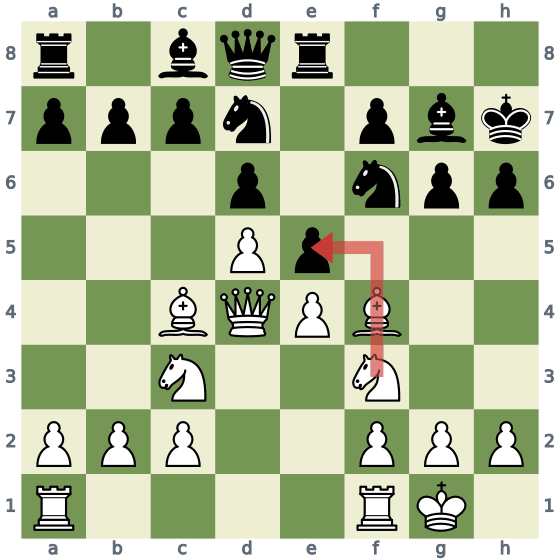
Rated 798 · Lichess Rapid 15+10 · move 11
White played 11.Nxe5, a blunder that left them losing. Find a better move.
Find the better move →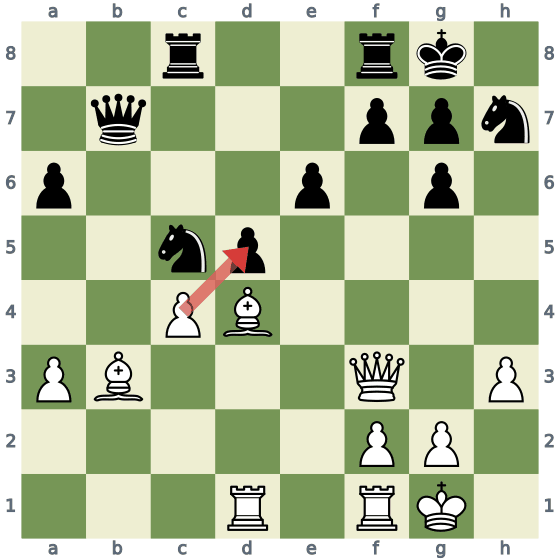
Rated 1218 · Lichess Blitz 3+2 · move 24
White played 24.cxd5, a blunder that left them losing. They went on to lose that game. Find a better move.
Find the better move →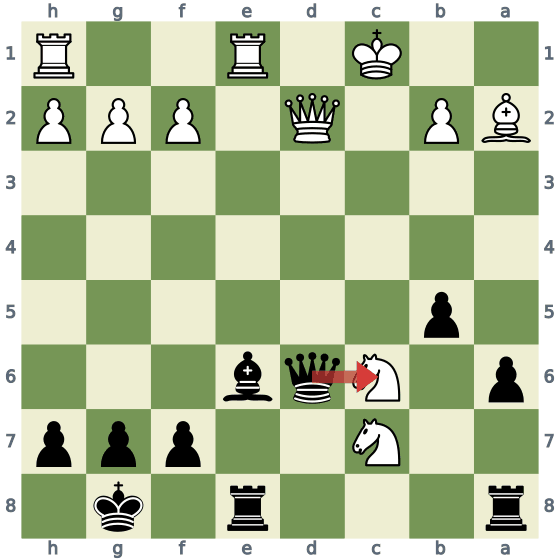
Rated 1207 · Lichess Rapid 10+0 · move 18
Black played 18...Qxc6+, but there was a much better move. Find it.
Find the better move →Positions from the sampled games, shown from the player's side. The red arrow is the move played; a link opens the position on the board, where the site tells you whether you found the better move.
To find your own, take your last twenty games, mark each blunder as one of the five kinds, and tally: how to analyze your own games has the method, step by step. Or let the report do it. A Chess Triage game review counts every blunder in your last 75 games by kind and emails you the positions to solve. It is free.
Related: why do I keep losing at chess? · chess blunders, and how to stop · how we count.
Check your own games: free chess game analysis · free chess game review · chess blunder checker.
How it works
1. Give us a username
Chess.com or Lichess. No account to make, nothing to install.
2. We go through every move
Your last 75 games, looking for the moments that keep costing you.
3. See what they've been hiding
In your inbox in about 15 minutes, with the positions to solve on the board.
Questions
How do I get better at chess?
Fix the moves that lose your games before learning anything new. In 5,364 lost games, 54% were decided by a piece left to be taken or a threat walked into, most of them with more than a minute on the clock. Before every move, name what the opponent can capture and what their last move threatens. Then analyze your own games to find which mistake you repeat, and practice those positions.
What is the best way to get better at chess?
Find the mistake you make most and work on that one. For most players under 1800 it is a hung piece or a missed threat, but which one, in what kind of position, and with how much time left differs from player to player. Twenty of your own games, with each blunder named, will tell you. General study comes second.
What is the fastest way to improve at chess?
Stop giving pieces away. A hung piece decides 27% of losses, 80% of hung pieces are taken on the very next move, and the fix is one question before each move: what can they take? Nothing else changes as many results for as little work.
Do puzzles make you better at chess?
They help you find wins, which is the smaller part of the problem: missed wins are 20% of mistakes, while a piece left to be taken or a threat not seen is 50%. Puzzles from your own games, starting from the move you got wrong, cover both.
Should I study openings to get better?
Under 800, enough to reach move 10 with your queen and a safe king, because 39% of losses at 400 and 30% at 600 are decided by then. From 1000 up it decides far fewer (15% at 1000, 9% at 1400), so the middlegame habits come first.
How do beginners get better at chess?
Two things, in order. Get through the first ten moves without losing a piece: develop, castle, and don't bring the queen out early. Then, before every move, check what the opponent can capture. Hung pieces decide 31% of losses at 600, and at 400 the piece hung most often is the queen (30% of them).
Will playing longer games make me better?
Not by itself. 87% of the moves that lost a game had more than 30 seconds on the clock, and 84% of hung pieces more than a minute. The time was there; the check wasn't made. Play the time control you enjoy and build the check.
Is it really free?
Yes. We're building a training tool around these reports and want honest feedback from real players. No card, no trial.
Do you need my password?
Never. Your games on Chess.com and Lichess are public; we read them through the sites' official APIs. We only need your username and an email to send the report to.
These are the averages. Get your own count.
Free report from your last 75 games on Chess.com or Lichess, in your inbox in about 15 minutes.
Get my free report