From the data
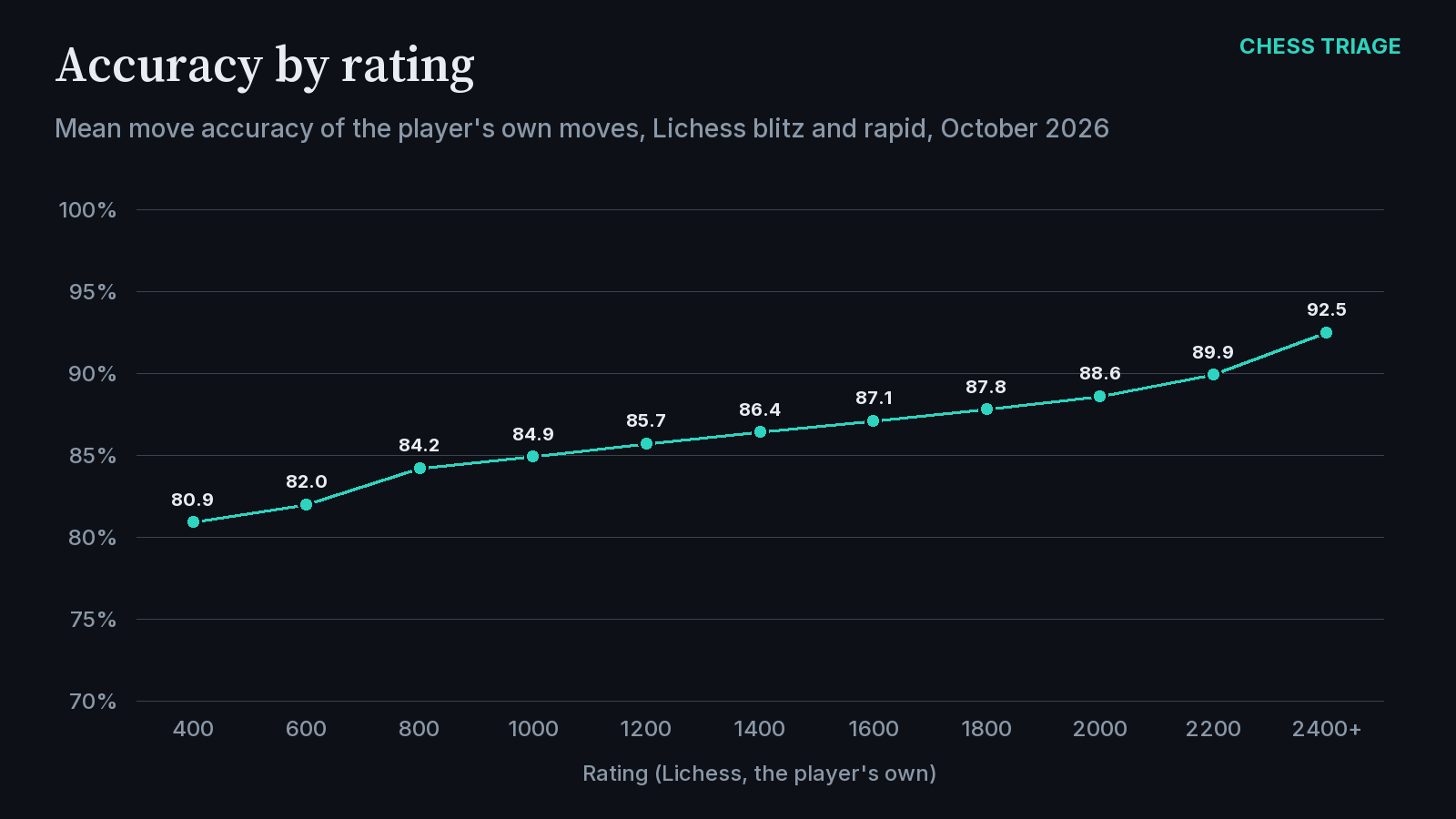
Chess accuracy by rating: what players actually score at 800, 1200, 1600 and 2000.
Accuracy is the number everyone looks at after a game and nobody can place. Is 85% good? Is 97% suspicious? We computed Lichess's per-move accuracy for every move after move 10 in 5,718 rated games, 600 or more at every rating, and counted. Here is the average at each level, how spread out it is, and why the figure on Chess.com is a different number.
Average accuracy at each rating
| Rating | Player-games | Mean | Median | 90 or more | 95 or more | 97 or more | Under 80 | Won games | Lost games |
|---|---|---|---|---|---|---|---|---|---|
| 400 | 828 | 80.9 | 81.9 | 16% | 4% | 1% | 41% | 83.1 | 78.9 |
| 600 | 1,138 | 82.0 | 82.6 | 16% | 3% | 1% | 37% | 84.2 | 79.4 |
| 800 | 1,114 | 84.2 | 84.8 | 22% | 4% | 1% | 25% | 86.2 | 81.8 |
| 1000 | 1,067 | 84.9 | 85.7 | 21% | 3% | 0% | 20% | 86.7 | 82.9 |
| 1200 | 1,041 | 85.7 | 85.8 | 24% | 3% | 1% | 15% | 87.5 | 83.8 |
| 1400 | 1,064 | 86.4 | 86.8 | 25% | 4% | 1% | 10% | 88.2 | 84.5 |
| 1600 | 1,052 | 87.1 | 87.3 | 29% | 4% | 0% | 7% | 88.6 | 85.6 |
| 1800 | 1,077 | 87.8 | 88.2 | 33% | 4% | 0% | 5% | 89.4 | 86.1 |
| 2000 | 1,104 | 88.6 | 88.9 | 40% | 5% | 1% | 3% | 90.0 | 87.2 |
| 2200 | 1,023 | 89.9 | 90.0 | 50% | 10% | 2% | 1% | 91.1 | 88.5 |
| 2400+ | 928 | 92.5 | 92.5 | 73% | 33% | 20% | 0% | 92.9 | 89.8 |
Accuracy per player-game is the mean of Lichess's per-move accuracy over the player's moves after move 10. The 90, 95, 97 and 80 columns are the share of the band's player-games at that level. The last two columns are the mean in games the player won and lost.
Three things to read off the table. First, the range is narrow: 80.9 at 400 to 92.5 at 2400 and above, because most moves in any game, at any level, cost nothing. The difference between a 1000 and a 2000 lives in a handful of moves a game, which is also why the per-move blunder rate falls fourfold across the same range while accuracy moves ten points.
Second, winning a game adds three or four points. At 1200 the mean is 87.5 in won games and 83.8 in lost ones. Part of that is playing well; part is that in a won game the opponent's mistakes make the best moves easy to find. The same player's accuracy swings with the opponent's play, which is the first reason a single game's number says little.
Third, high scores are rare below 2000 and ordinary above it. 3% of 1200-rated player-games scored 95 or higher; 5% at 2000; 33% at 2400 and above. A 97 was scored by under 1% of player-games at every rating up to 2000, by 2% at 2200 and 20% at 2400 and above.
How the number is calculated
Lichess publishes its formula. Each position's engine evaluation is turned into a win percentage for the player to move; each move's accuracy is a function of how many points of win percentage it gave away (none lost is 100, a 15-point blunder is about 50, a 30-point one about 25); the game's accuracy combines the moves, with a harmonic mean in the mix so that one bad move pulls the game's figure down harder than the plain average would. Lichess's own page says a very high accuracy is not by itself a sign of superhuman play, and that the number is not a test score.
The figures on this page use that per-move formula with the report's engine settings, averaged plainly over the player's moves after move 10. Two consequences: our numbers run a little higher than the figure Lichess shows for the same game, because the harmonic mean isn't in them and the opening (where accuracy is highest) is left out; and they are comparable across ratings, which is the point of the table.
Chess.com's accuracy is a different number. It is produced by CAPS2, Chess.com's own method, which it describes but does not publish: moves are compared with the engine's choices and the score is scaled so that, in its words, most scores fall between 50 and 95. The published figures that exist for Chess.com come from a 2023 article by GM Larry Kaufman on Chess.com's blog, for rapid games: about 69% at 400, 76% at 1000, 81% at 1600, 84% at 2000, 89% at 2400. Those run three to thirteen points below the Lichess-formula figures in the table above for the same ratings, the gap widest at the low end, and that is the scaling, not the players. The same game analyzed on both sites gets two accuracies, and neither is wrong; they are different scales. The Lichess vs Chess.com accuracy article goes through both methods and the gap at each rating.
Is 97% accuracy cheating?
No, not on its own, and both sites say so. What produces a 97 in a single game, in this data:
- An opponent who blundered early. When the opponent hangs a piece, the best move is to take it, and every move after that in a won position tends to score high. Won games average three to four points above lost ones at every rating, and the gap is the opponent's doing as much as the player's.
- A theory-heavy opening. The first ten to fifteen moves of a known opening are, by definition, the engine's moves or close to them. On Lichess they count toward the game's figure; here they don't.
- A blunder-free game. Player-games with no blunder at all averaged 92.8 across the sample. Any player has those; the question is how often, and that is a question about many games, not one.
What one game can't tell you is whether the player plays like that in general. 1% of 1200-rated player-games scored 97 or more; an honest 1200 who plays fifty games will have one. A player who scores 97 in most games while rated 1200 is a different matter, and that is what both sites' fair-play systems look at: the pattern over many games, the time spent per move, and the moves' agreement with an engine in positions where humans disagree with it. If you suspect someone, report the account; the sites can see what a single accuracy figure can't.
What to look at instead
Accuracy summarizes a game into a grade and throws away what made the grade. The number that actually points at something to work on is the count of your mistakes by kind: how many pieces you left to be taken, how many threats you walked into, how many wins you missed, and how many of those came while you were ahead. Those are what Chess Triage counts over your last 75 games, with the positions to solve, and they are the numbers that change when you fix a habit. Accuracy follows them.
What's behind your accuracy?
Chess Triage checks every move of your last 75 games on Chess.com or Lichess, counts the mistakes that keep costing you by kind, and emails you the positions to solve on the board. Free, no card, just your username.
Get my free reportSee a full sample report · One in five won games gets thrown away
Check your own games: free chess game analysis · free chess game review · chess blunder checker.
Questions
What is a good chess accuracy?
By Lichess's formula over the moves after move 10, the average is 84.2 at 800, 85.7 at 1200, 87.1 at 1600 and 88.6 at 2000. A game five points above your level's average is a good game; a game five below is one with a blunder in it. Chess.com's figure for the same game is lower by its own scaling.
What accuracy does a 1000-rated player have?
84.9 on average in this sample (median 85.7), with 21% of games at 90 or above and 20% below 80. Chess.com's published figure for 1000-rated rapid players is about 76%, on Chess.com's own scale.
Is 97% accuracy cheating in chess?
Not by itself. 20% of 2400+ player-games and under 1% of games below 2000 scored 97 or higher in this sample, and a short game, an early blunder by the opponent, or a known opening will produce one for anybody. Cheating detection looks at the pattern across many games and at move times, not at one accuracy figure. If something looks wrong, report the account and let the site look.
Why is my accuracy different on Lichess and Chess.com?
Because they are different formulas. Lichess publishes its (win-percentage drop per move, combined with a harmonic mean); Chess.com's CAPS2 is unpublished and scaled so that most scores fall between 50 and 95. The same game typically reads several points lower on Chess.com. Compare games within one site, not across them.
Does accuracy depend on my opponent?
Yes, strongly. In this sample players scored three to four points higher in games they won than in games they lost at every rating, and much of that is the opponent's mistakes making the best moves obvious. A single game's accuracy is as much about the other player as about you.
How we counted
Rated blitz and rapid games from the Lichess open database for October 2026, both players in each game: 5,718 games, 11,436 player-games, 600 games or more in every 200-point band from 400 to 2400 and above, each player counted under their own rating. Every move after the first ten was run through Stockfish at the same depth the report uses, with the moves that make the report checked again more deeply. A blunder is a move that cost 15 or more points of winning chance, a mistake 10 or more (Lichess's thresholds); the first ten moves of each game are not counted, as in the report. The types are the report's own: a hung piece is one the opponent could simply take; a missed threat is a move that let the opponent's tactic in; "judgment" is a mistake with no material change in the engine's lines. Full tables are in the mistakes-by-rating article. We have no stake in any site named here.