From the data
Chess mistakes by rating: what 5,718 games actually show.
Every list of "common mistakes at 1000" is somebody's impression. We ran the report's own engine checks over a month of rated Lichess games, 600 or more at every rating from 400 to 2400 and above, and counted. Here is how often players blunder at each level, what the blunders are, when in the game and on the clock they happen, and what changes as you go up.
To see what these blunders look like, chess puzzles by rating has three real ones from this sample for each level, to solve on the board.
How often a blunder happens
A blunder here is the report's definition: a move that cost 15 or more points of winning chance by Stockfish's count, the threshold Lichess uses. Counted per game, the number falls only slowly across the club range: 3.1 at 400, 2.6 at 1000, 2.3 at 1600, and faster above that, reaching 1.2 at 2400 and above. 86% of 1000-rated player-games had at least one; so did 79% at 2000.
Per game is the wrong unit, though. A 400-rated game in this sample lasts 26 moves, a 2400 game 50. Count blunders per move instead and the picture is what you'd expect: 1.2 per ten moves at 400, 0.79 at 1200, 0.58 at 1800, 0.23 at 2400 and above. Stronger players don't blunder less per game because they're still blundering. They blunder less per move and the games last longer.
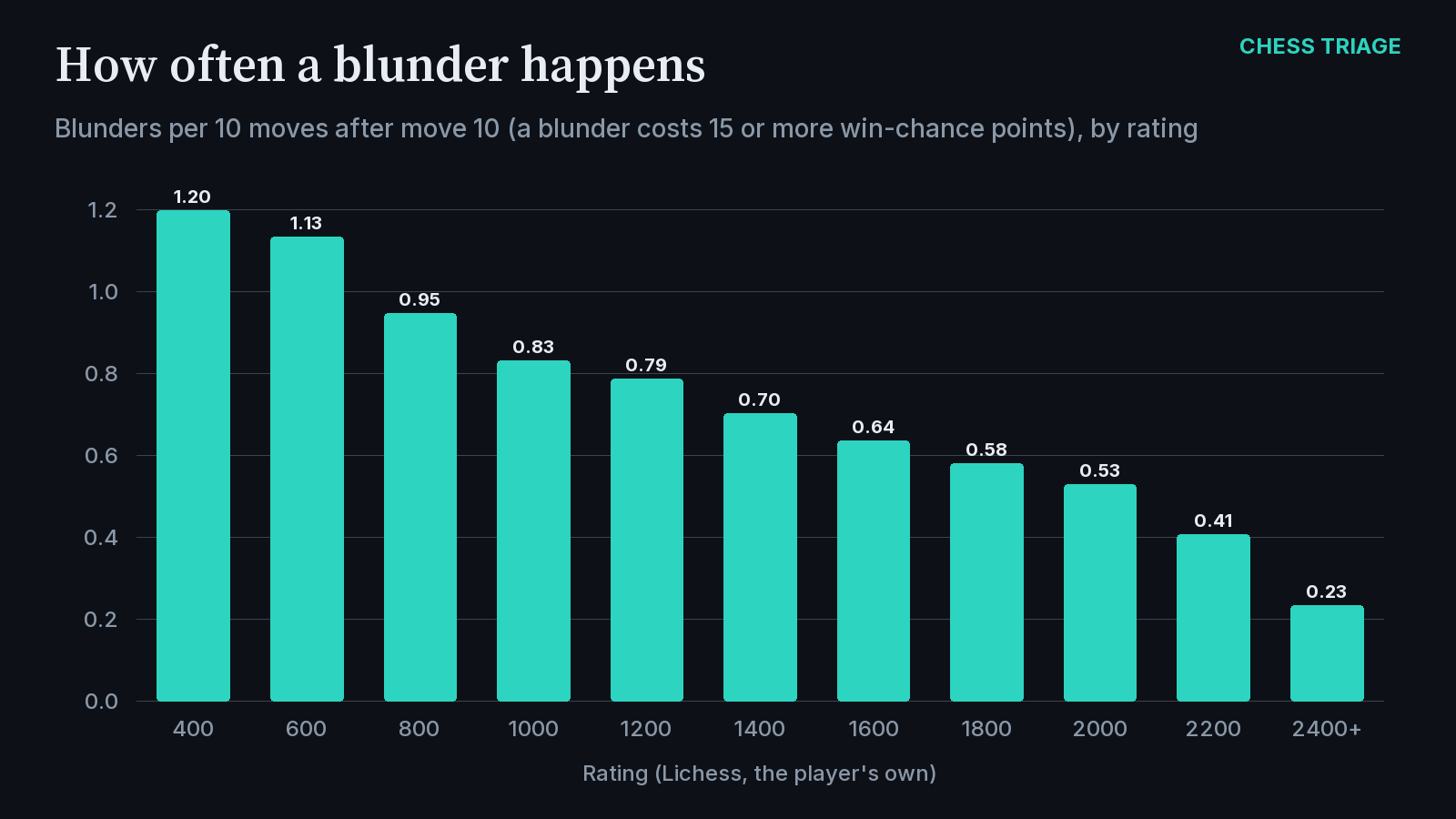
| Rating | Player-games | Moves a game | Accuracy | Blunders a game | Per 10 moves | Games with a blunder | Hung pieces a game |
|---|---|---|---|---|---|---|---|
| 400 | 828 | 26 | 80.9 | 3.1 | 1.20 | 87% | 0.71 |
| 600 | 1,138 | 26 | 82.0 | 2.9 | 1.13 | 86% | 0.68 |
| 800 | 1,114 | 29 | 84.2 | 2.7 | 0.95 | 84% | 0.65 |
| 1000 | 1,067 | 31 | 84.9 | 2.6 | 0.83 | 86% | 0.58 |
| 1200 | 1,041 | 33 | 85.7 | 2.5 | 0.79 | 84% | 0.57 |
| 1400 | 1,064 | 33 | 86.4 | 2.3 | 0.70 | 83% | 0.57 |
| 1600 | 1,052 | 36 | 87.1 | 2.3 | 0.64 | 80% | 0.52 |
| 1800 | 1,077 | 36 | 87.8 | 2.1 | 0.58 | 77% | 0.47 |
| 2000 | 1,104 | 39 | 88.6 | 2.0 | 0.53 | 79% | 0.39 |
| 2200 | 1,023 | 41 | 89.9 | 1.6 | 0.41 | 72% | 0.36 |
| 2400+ | 928 | 50 | 92.5 | 1.2 | 0.23 | 53% | 0.24 |
Accuracy is the mean of Lichess's per-move accuracy over the player's moves after move 10. Moves a game counts the player's own moves.
What the mistakes were
The report sorts every mistake and blunder by what went wrong. Three kinds account for most of them at every level, but their shares swap places as rating rises.
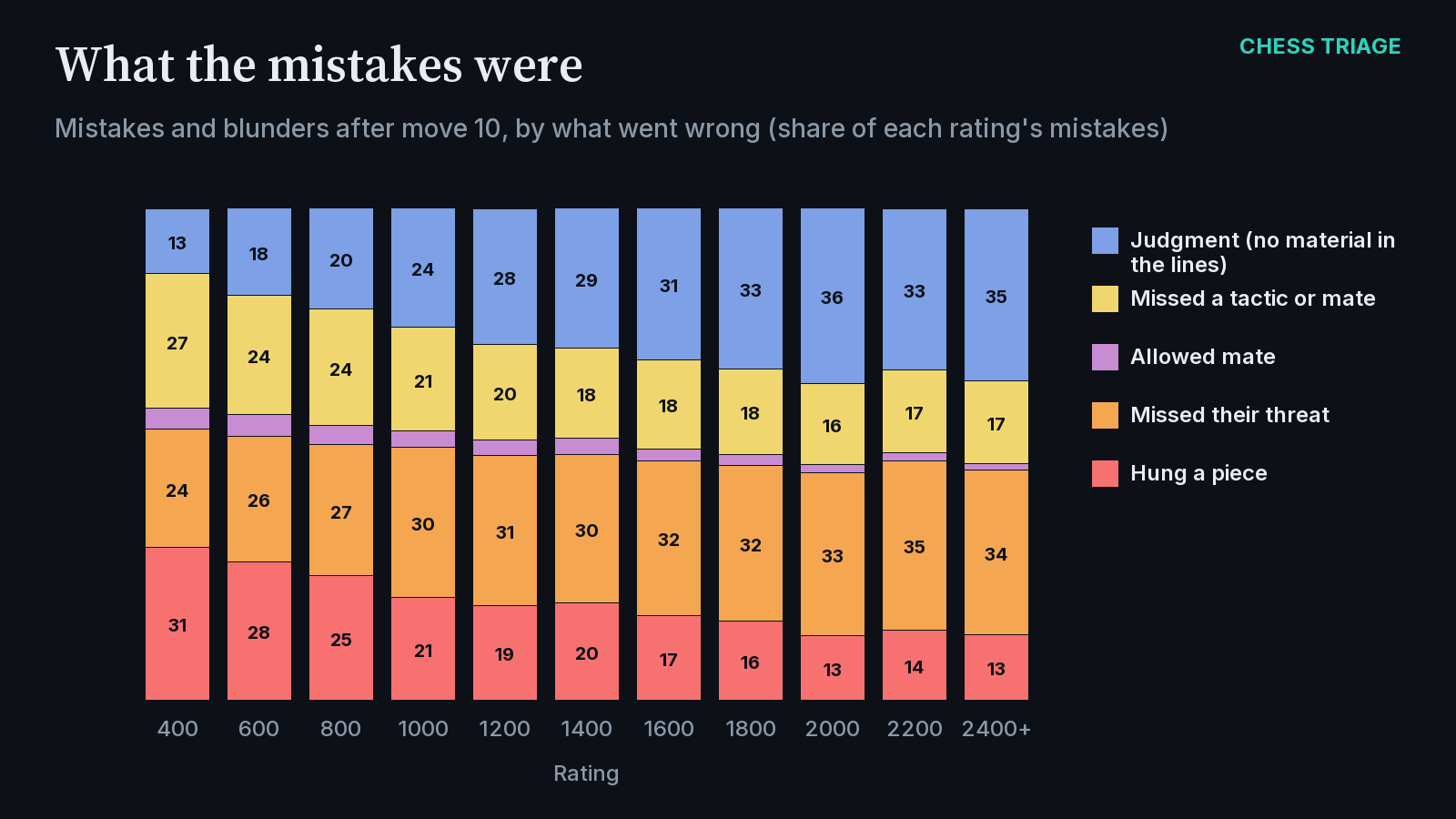
- Hung a piece: a move that left a piece for the taking, nothing cleverer than that. 31% of mistakes at 400 and 28% at 600, 21% at 1000, 17% at 1600, 13% at 2400 and above. It is the beginner's mistake, and it never goes away entirely: a 2000-rated player still hangs a piece in one game in three (0.39 a game).
- Missed their threat: the move walked into something the opponent had set up, a fork, a pin, a mate, a loose pawn. 24% at 400, 31% at 1000, the largest single type from 800 to 1600, and 34% at 2400 and above, level with judgment calls.
- Missed a tactic: a win was on the board and the player played something else. 27% at 400, 20% at 1200, 17% at 2400 and above. The missed mates within that go from 7% to 3%.
- Judgment: the engine's lines show no material changing hands, so the mistake is a plan, a trade, a pawn structure, the wrong square. 13% at 400, a third of all mistakes from 1800 up. This is the part a tactical report can't teach, and the reason it says it is for players up to about 1800.
By the report's finer categories, across all ratings: Judgment 28%, Hanging Piece 16%, Loose Pawn 14%, Fork 6.9%, Exchange Count 6.5% (a trade that came out behind), Checkmate 6.2%, Pin and Skewer 5.8%, with discovered attacks, checks that win material, chased pieces, double attacks, removed defenders, passed pawns, sacrifices and mate threats sharing the last 17%.
Which piece gets hung
At 400 it is the queen, in 30% of hung pieces. From 1200 upward it is the rook, in a quarter to a third of them, with the queen second. Pawns count here too: a pawn left to be taken for nothing is 14% of the total across all ratings and 19% at 2400 and above, where the pieces are mostly safe and the pawns aren't.
| Rating | Queen | Rook | Knight | Bishop | Pawn | Hung a game |
|---|---|---|---|---|---|---|
| 400 | 30% | 23% | 22% | 18% | 7% | 0.71 |
| 600 | 26% | 23% | 22% | 22% | 7% | 0.68 |
| 800 | 24% | 25% | 22% | 15% | 14% | 0.65 |
| 1000 | 26% | 23% | 22% | 17% | 12% | 0.58 |
| 1200 | 22% | 26% | 20% | 15% | 17% | 0.57 |
| 1400 | 22% | 27% | 18% | 15% | 19% | 0.57 |
| 1600 | 23% | 27% | 18% | 15% | 17% | 0.52 |
| 1800 | 26% | 26% | 16% | 15% | 16% | 0.47 |
| 2000 | 21% | 27% | 21% | 16% | 16% | 0.39 |
| 2200 | 20% | 30% | 17% | 17% | 17% | 0.36 |
| 2400+ | 19% | 32% | 17% | 13% | 19% | 0.24 |
Share of the band's hung pieces (and pawns) by what was given away.
When in the game, and when on the clock
Hung pieces are a middlegame habit: 72% happen there, 11% in the opening (after move 10) and 18% in the endgame. By move number, 46% of them come on moves 11 to 20 and another 29% on 21 to 30: the pieces are out, the position is full, and something gets left behind. 80% were taken on the very next move. The hanging pieces page has the full breakdown.
The clock gets blamed for blunders far more than it deserves. Across all ratings 11% of blunders were made with under 30 seconds left, and the share is lowest where the blunders are most common: 4% at 400, 7% at 800, 8% at 1200. It rises to 10% at 1600, 23% at 2200 and 34% at 2400 and above, where the games are long and close enough that the clock decides them. In rapid, 1.2% of blunders came under 30 seconds; in blitz, 15%.
| Rating | Mistakes made while winning | While better | While level | Blunders in the last 30 seconds | Losses with a mistake while level or ahead | Lost from a winning position |
|---|---|---|---|---|---|---|
| 400 | 41% | 15% | 22% | 4% | 47% | 19% |
| 600 | 39% | 16% | 25% | 5% | 58% | 17% |
| 800 | 35% | 19% | 27% | 7% | 62% | 16% |
| 1000 | 31% | 19% | 31% | 5% | 73% | 18% |
| 1200 | 29% | 20% | 33% | 8% | 77% | 19% |
| 1400 | 25% | 21% | 35% | 8% | 82% | 19% |
| 1600 | 24% | 21% | 37% | 10% | 81% | 15% |
| 1800 | 24% | 21% | 37% | 13% | 85% | 15% |
| 2000 | 24% | 19% | 39% | 17% | 85% | 15% |
| 2200 | 22% | 21% | 38% | 23% | 81% | 12% |
| 2400+ | 22% | 21% | 40% | 34% | 78% | 7% |
Winning: a win chance of 75% or more before the move; better: 60 to 75; level: 40 to 60. The last two columns are shares of the band's losses and of all its player-games. The low bands' "losses with a mistake" figure is held down by the first ten moves being skipped: many 400-rated games are decided before move 11.
The last column is the one a club player should sit with: at 1200, one player-game in five was lost from a winning position. Not from level, from winning. The thrown-wins article counts the same thing over 935,000 player-games with Lichess's own evaluations and gets the same shape.
Blitz against rapid
Blitz players in the sample averaged 86.9 accuracy and 2.2 blunders a game; rapid players 84.9 and 2.5. That looks backward until you notice that the rapid games are the lower-rated ones (nearly half the rapid player-games are under 1000, a fifth of the blitz ones) and 8,096 of the 11,436 player-games are blitz. The rapid players average 1190 rated, the blitz players 1630. What differs between the two is the clock: 15% of blitz blunders came under 30 seconds against 1.2% in rapid.
By rating, in detail
Each level has its own page with the counts above, the three causes that decide its games, real positions from the sample to solve, and what to check before you move.
More from the data
The same sample, asked different questions: what the move that lost each game was, how often the clock decides a game, what changes between blitz and rapid, and why the same game scores differently on Lichess and Chess.com.
Which of these is yours?
These are the averages. Your games have their own count. Chess Triage runs the same checks over your last 75 games on Chess.com or Lichess, counts your mistakes by kind, and emails you the positions to solve. Free, no card, just your username.
Get my free reportSee a full sample report · One in five won games gets thrown away
Check your own games: free chess game analysis · free chess game review · chess blunder checker.
Questions
How many blunders does a 1000-rated player make per game?
About 2.6 in a rated blitz or rapid game after move 10, by the Lichess threshold (15 or more points of winning chance lost), and 86% of 1000-rated player-games have at least one. Per ten moves it is 0.83, against 1.2 at 400 and 0.53 at 2000.
What is the most common chess mistake?
Below 800, hanging a piece: 28% to 31% of all mistakes, most often the queen at 400. From 800 to 1600, walking into the opponent's threat (a fork, a pin, a mate, a loose pawn) is the largest type, 27% to 32%. From 1800 up, mistakes with no material in the engine's lines (judgment) are a third of the total, level with the threats.
Do stronger players blunder less?
Per move, yes, four times less at 2400 than at 400. Per game the difference is small until 1800, because stronger players' games are twice as long: 50 moves at 2400 and above against 26 at 400.
Are most blunders caused by time pressure?
No. 11% of blunders in the sample were made with under 30 seconds left, and only 7% at 800. Time pressure matters most above 2000, where a third of blunders come in the last 30 seconds.
Where does the data come from?
The Lichess open database for October 2026 (rated blitz and rapid games, released under the CC0 license), sampled so that every 200-point band from 400 to 2400 and above has at least 600 games, analyzed by Stockfish with the same settings as a Chess Triage report. The sample doesn't need Lichess's own evaluations, so it isn't skewed toward games somebody chose to analyze.
How we counted
Rated blitz and rapid games from the Lichess open database for October 2026, both players in each game: 5,718 games, 11,436 player-games, 600 games or more in every 200-point band from 400 to 2400 and above, each player counted under their own rating. Every move after the first ten was run through Stockfish at the same depth the report uses, with the moves that make the report checked again more deeply. A blunder is a move that cost 15 or more points of winning chance, a mistake 10 or more (Lichess's thresholds); the first ten moves of each game are not counted, as in the report. The types are the report's own: a hung piece is one the opponent could simply take; a missed threat is a move that let the opponent's tactic in; "judgment" is a mistake with no material change in the engine's lines. Full tables are in the mistakes-by-rating article. We have no stake in any site named here.