From the data
One in five won games gets thrown away. We counted 467,000 Lichess games.
Rated blitz and rapid games on Lichess from September 2026, both players in each. Every time a player got clearly winning, we followed the game to the end. Here is how often the win survived, by rating, and what the move that lost it looked like.
How often a win survives
We took the rated blitz and rapid games from the September 2026 Lichess database that carry Lichess's own server evaluation, and looked at each player in each game: 935,200 player-games in about 467,000 games. A player counts as clearly winning when the evaluation after three of their own moves in a row is at least +3 (a piece up with nothing to show for it) or a forced mate. That happened 413,855 times. Then we checked how the game ended for them.
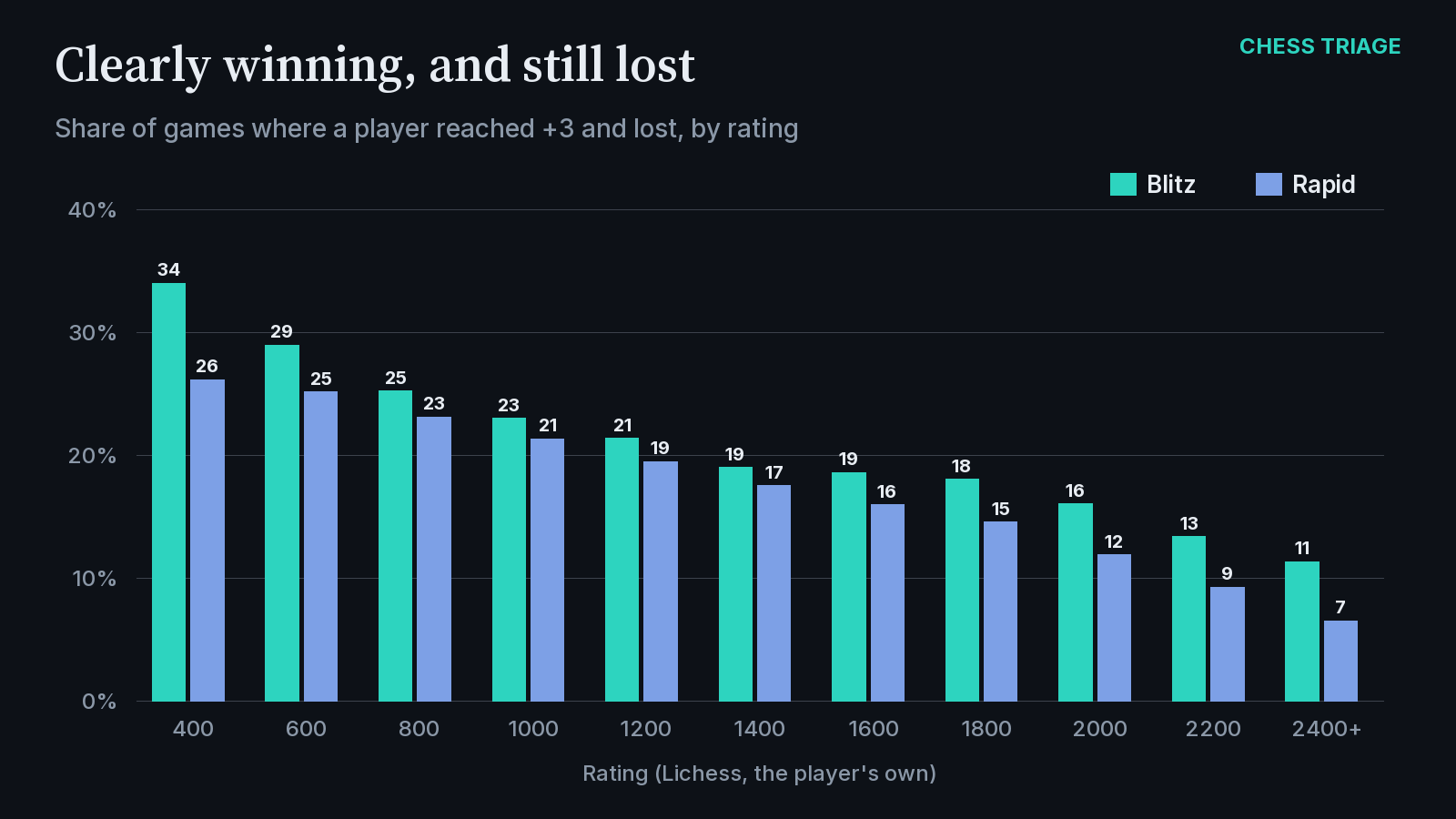
18.5% of them lost, and 3.3% drew. Put another way: of every five games a player reaches a clearly won position in, one is not won. And it is strongly tied to rating.
| Rating | Player-games | Got clearly winning | Then lost | Then drew | Thrown wins as a share of all losses |
|---|---|---|---|---|---|
| 400 | 2,923 | 1,292 | 29.3% | 2.4% | 22.7% |
| 600 | 17,281 | 8,616 | 26.9% | 3.1% | 26.1% |
| 800 | 54,759 | 26,791 | 24.2% | 3.1% | 23.9% |
| 1000 | 99,686 | 47,521 | 22.2% | 3.0% | 21.8% |
| 1200 | 135,855 | 61,811 | 20.5% | 3.0% | 19.2% |
| 1400 | 167,959 | 74,308 | 18.3% | 3.1% | 16.8% |
| 1600 | 163,227 | 70,111 | 17.4% | 3.3% | 15.5% |
| 1800 | 135,017 | 57,321 | 16.6% | 3.5% | 14.6% |
| 2000 | 85,672 | 35,791 | 14.6% | 3.8% | 12.9% |
| 2200 | 46,566 | 19,187 | 12.5% | 4.6% | 11.4% |
| 2400+ | 26,255 | 11,106 | 10.8% | 4.5% | 11.0% |
| All | 935,200 | 413,855 | 18.5% | 3.3% | 17.0% |
The last column is the one to sit with. Between 600 and 1000, about one loss in four was a game the player had already won. Even at 2400 it is one in nine. If you are a club player who loses ten games a month, two or three of them were yours.
Blitz and rapid differ less than you might expect in the shape of the curve, but blitz is worse everywhere: 19.1% of clearly won blitz games were lost against 17.7% of rapid games, and at 400 rated the blitz figure is 34%.
What the losing move was
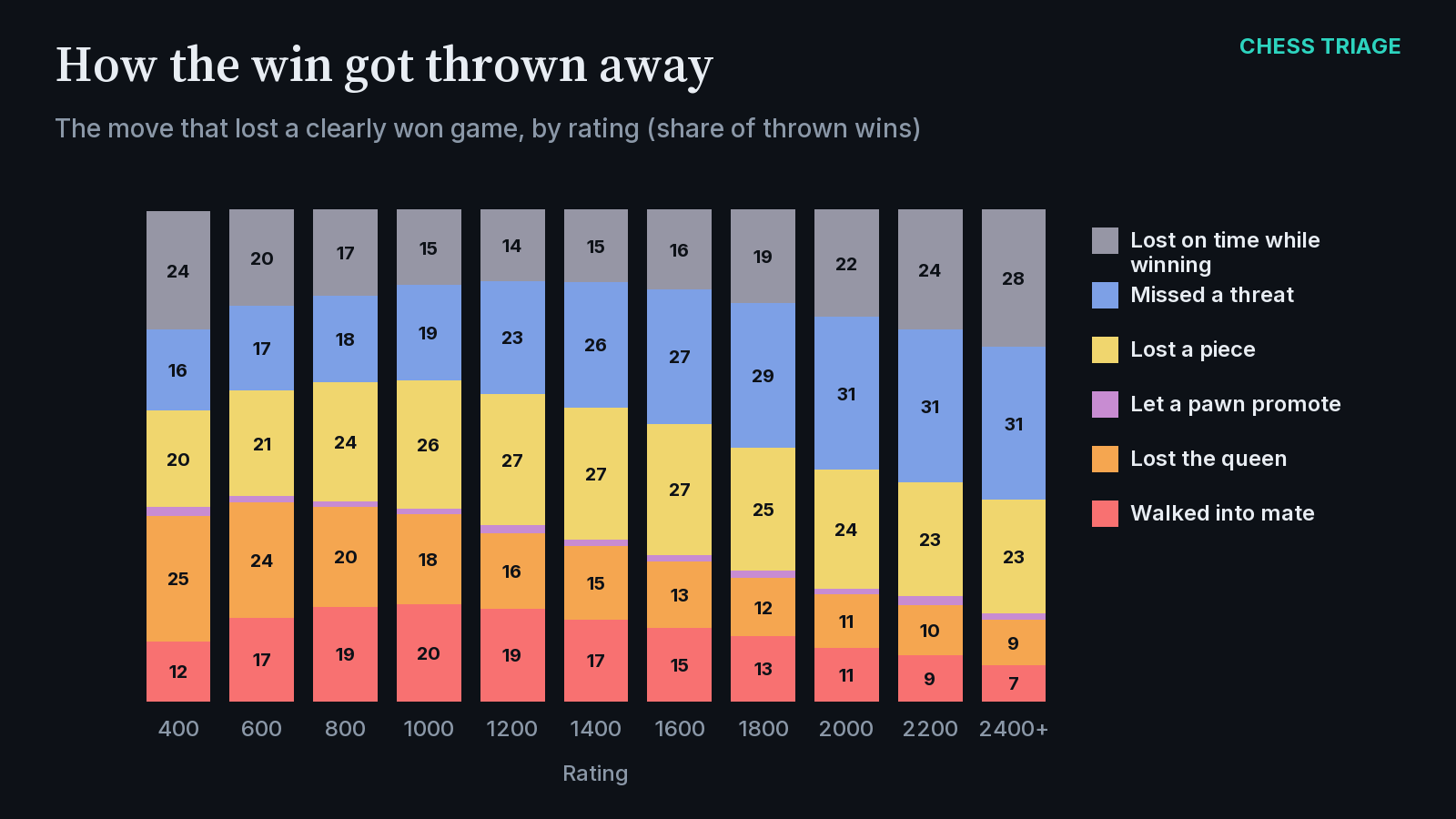
For every thrown win we found the move that threw it: the player's own move, after they got winning, with the biggest drop in winning chances. Then we looked at what it cost.
| What the move cost | All ratings | At 400 to 800 | At 1200 to 1600 | At 2000+ |
|---|---|---|---|---|
| A piece | 25.7% | 20 to 24% | 27% | 23 to 24% |
| Nothing at once: a threat was missed | 24.8% | 16 to 18% | 23 to 28% | 31% |
| The game, on the clock, while still winning | 16.8% | 17 to 24% | 14 to 16% | 22 to 28% |
| The queen | 14.4% | 20 to 25% | 13 to 15% | 9 to 10% |
| Walked into mate, or allowed a forced mate | 16.1% | 13 to 19% | 15 to 19% | 8 to 11% |
| Let a pawn promote | 1.4% | 1 to 2% | 1 to 2% | 1 to 2% |
Three things stand out.
Below 1000, the win is lost with a bang. The queen goes, or the king does. A quarter of thrown wins at 400 are a queen dropped outright, and another 12% walk straight into mate. These are not deep ideas: the opponent made a threat and the winning side did not look.
From 1200 up, the single biggest cause is a quiet one. The move loses nothing on the spot. It just misses what the opponent is threatening, and the position unravels over the next few moves. By 2000 that is nearly a third of all thrown wins. It is the hardest kind to notice in your own games, because nothing obvious happened on the move itself.
The clock takes over at the top. At 2400, 28% of thrown wins are flags while still winning. In blitz, the median clock at the losing move falls from 128 seconds at 400 rated to 17 seconds at 2400. Strong players do not stop blundering under pressure; they move the pressure to the clock.
When it happens
Wins do not slip away slowly. The median win lasted seven of the player's own moves before the losing move; 41% were gone within five moves of becoming winning. Converting means the first few moves after the material comes in, not a long technical phase.
In blitz, 30% of the losing moves were played with under 30 seconds on the clock. In rapid, 6%. The median rapid player had nearly six minutes left when the win went: the time was there, the check wasn't.
And they are not small swings. 17,927 of the 76,535 thrown wins we counted went from +5 or better to -3 or worse in a single move. The longest we found was a blitz game won for 81 of the player's own moves, until one rook move allowed a forced mate.
What to do with this
Right after you win material, check their checks and captures
The data says the next five moves are where it goes. Before each one: can they check me? Can they take anything? Is my queen on a square that can be hit with tempo? That one habit covers the queen, the mate and most of the hanging pieces in the chart above.
Decide what the clock is for
If you flag winning positions in blitz, the fix is not more calculation. Bank time while you are winning: trade down, make the safe move fast, keep 30 seconds for the end. In rapid, the opposite: when the material comes in, that is the moment to spend a minute.
Find out which one is you
The population numbers say what club players do. They don't say what you do. Across 75 games, one player hangs the queen in won positions, another never does but misses the quiet threat every time, a third flags. The fix is different for each, and you only know which from your own games.
Your games have these too.
Chess Triage checks every move of your last 75 games on Chess.com or Lichess, counts the mistakes that keep costing you, and emails you the positions where your wins slipped away, to solve on the board. Free, no card, just your username.
Get my free reportHow we counted
Source: the Lichess open database (CC0), standard rated games, September 2026, blitz and rapid only; we read the first 2 GB of the month's file, which is where the 467,000 games come from. Only games with Lichess's server evaluation carry the [%eval] tags we need, which is roughly one game in twelve, so the sample leans toward games that someone asked Lichess to analyze afterward. Each game counts twice, once for each player, so the tables count player-games. Rating bands are the player's own rating at the time, in 200-point steps; 2400+ includes everyone above. "Clearly winning" is an evaluation of +3 or a forced mate, from the player's side, after three of their own moves in a row. The losing move is the player's own move, after they got winning, with the largest drop in winning chances (the Lichess win-probability curve). "Lost on time" means the game ended on the clock while the evaluation was still +3 or better. Bullet and correspondence games, games against the computer and unrated games are excluded. We'll re-run the count on later months; if the shape changes, this page will say so.