Losing on time · from the data
Why do I keep losing on time?
Because of the clock you chose, mostly. We read the result and the reason for every rated game in a 1 GB slice of October's Lichess database, 2,891,490 decisive games, and counted how many were lost on time at each rating in bullet, blitz, rapid and classical. The share barely moves with rating. It moves with the time control, and with what you do in the first twenty moves.
2,891,490 decisive rated games, every time control, Lichess, October 2026
How often games are lost on time
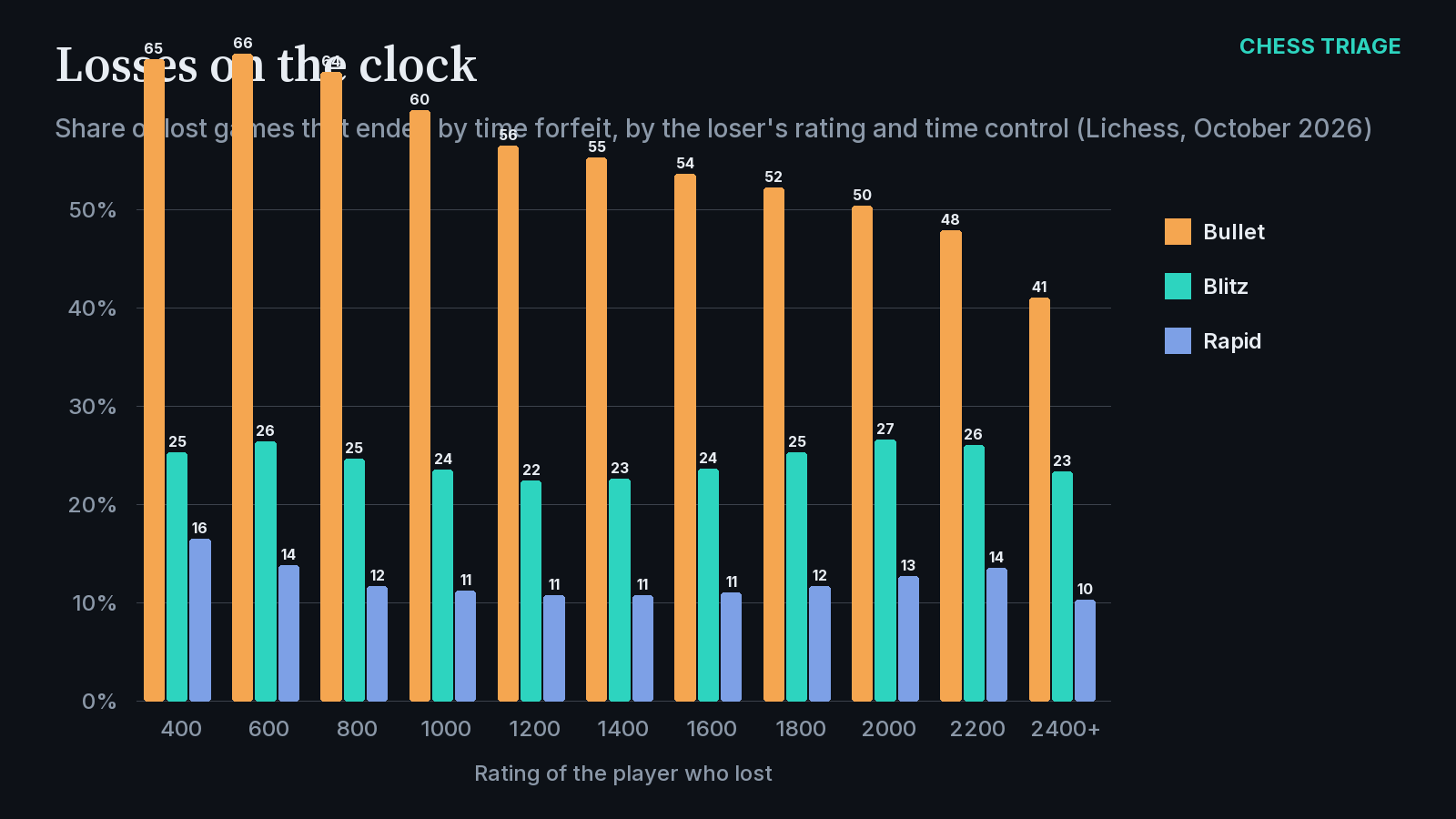
Lichess records why each game ended. In this slice, 1,048,057 bullet games, 1,343,309 blitz games, 483,821 rapid games and 16,303 classical games ended with a winner (draws left out). The share decided by a flag falling: 53% in bullet, 24% in blitz, 11% in rapid, 9% in classical. One blitz loss in four is a flag. One bullet loss in two.
| Rating | Losses | Bullet | Blitz | Rapid | All time controls |
|---|---|---|---|---|---|
| 400 | 6,752 | 65% | 25% | 17% | 25% |
| 600 | 37,658 | 66% | 26% | 14% | 28% |
| 800 | 129,844 | 64% | 25% | 12% | 30% |
| 1000 | 255,601 | 60% | 24% | 11% | 30% |
| 1200 | 388,106 | 57% | 22% | 11% | 29% |
| 1400 | 512,417 | 55% | 23% | 11% | 30% |
| 1600 | 560,071 | 54% | 24% | 11% | 31% |
| 1800 | 494,104 | 52% | 25% | 12% | 34% |
| 2000 | 305,953 | 50% | 27% | 13% | 38% |
| 2200 | 135,592 | 48% | 26% | 14% | 40% |
| 2400+ | 65,392 | 41% | 23% | 10% | 37% |
Share of the band's lost games that ended by time forfeit. The last column rises with rating only because stronger players play more bullet and blitz.
Read across a row and the number hardly changes. A 1200-rated blitz player loses on time in 22% of their losses; a 2000 in 27%; an 800 in 25%. In rapid it is 12% at 800, 11% at 1200, 13% at 2000. Getting better at chess does not get you out of losing on time; stronger players lose on the clock just as often, they just do it later in longer games. What changes the share is the time control, by a factor of five between rapid and bullet.
What the position was when the flag fell
For the games Lichess had analyzed (about one in forty, the ones somebody asked for analysis on, so a little skewed toward interesting games), the last evaluation says what the flagged player's position was. In blitz, 24% of the players who lost on time were winning when they did, by a pawn and a half or more, or with a mate on the board; 17% were level; 60% were losing anyway. In rapid, 20% were winning; in bullet, 36%.
| Rating | Winning when flagged | Level | Losing anyway | Winner had over a minute left | Winner had under 15 seconds |
|---|---|---|---|---|---|
| 400 | 37% | 5% | 58% | 64% | 14% |
| 600 | 37% | 10% | 53% | 48% | 24% |
| 800 | 36% | 11% | 54% | 36% | 33% |
| 1000 | 33% | 13% | 54% | 31% | 38% |
| 1200 | 30% | 14% | 56% | 28% | 40% |
| 1400 | 28% | 15% | 57% | 26% | 43% |
| 1600 | 27% | 16% | 57% | 22% | 47% |
| 1800 | 27% | 16% | 57% | 16% | 53% |
| 2000 | 27% | 17% | 57% | 11% | 60% |
| 2200 | 25% | 18% | 58% | 6% | 69% |
| 2400+ | 24% | 18% | 59% | 3% | 78% |
All time controls together. Position columns: the analyzed games only. Clock columns: every time-forfeit game with clock data; the winner's clock is their time at their last move.
Three losses in five on the clock were losses anyway, at every rating. That matters for the fix: most flags are not thefts, they are the end of a game that was already going badly, with the clock as the formality. But at 800 to 1000, over a third of flagged players were winning, and even at 2400 it is nearly a quarter. Those are the ones to work on, and they are the same games the thrown-wins article counts: of clearly won games that were then lost, the clock took 19% in blitz and 8% in rapid at 1200.
It is usually not a scramble
Look at the winner's clock. In blitz, when the flag fell the winner still had more than a minute in 42% of games and 15 to 60 seconds in 37%; in only 21% was the winner also under 15 seconds. In rapid the winner had over a minute in 89% of flag games. Bullet is the exception: 69% of bullet flags fell with the winner also under 15 seconds, which is a scramble by any definition.
So in blitz and rapid the player who flagged was not out-scrambled. They spent their time earlier than their opponent did, and the deficit was already there before the scramble began. The games say where: time-forfeit games are longer than the others, 59 moves against 47 in blitz, 51 against 46 in rapid. A player who flags has usually got into a long game with a clock budgeted for a short one.
Above 2000 the picture shifts toward the scramble (69% of winners under 15 seconds at 2200), because those games are mostly 3+0 and both players are playing the clock. Below 1600 it is nearly always one player running out while the other has time to spare.
What to do about it
Budget the first twenty moves. The games lost on time run a quarter longer than the others, and the winner usually has a minute or more left, so the time went in the opening and early middlegame. In a 5-minute game, be at move 20 with three minutes; in 10+0, with six. If you are not, the problem is not the endgame scramble, it is the ten-second thinks on move 8.
When you are winning, stop calculating. A quarter of blitz flags came from a winning position. Material up, trade pieces, push the passed pawn, play the move you can make in two seconds. Finding the fastest win costs the time that loses the game.
Choose the clock you can live with. Rapid loses one game in nine on time, blitz one in four, bullet one in two, at every rating. If flag losses are a quarter of your blitz losses, that is not a weakness, that is blitz. An increment (3+2 instead of 3+0) changes what a flag means, though this count doesn't split increment from non-increment and we won't pretend it does.
What the data says is not the cause: your rating. Within a time control the share is flat from 400 to 2400. And what losing on time usually isn't: a close game thrown away. Three in five were losing anyway. The losing page counts what actually lost those, and it was a move, with time on the clock.
Is it the clock, or the move?
The report tells the two apart. It checks every move of your last 75 games on Chess.com or Lichess, counts your blunders by kind, and says how many came with under 30 seconds on the clock. If most did, your problem is the budget above. If most came with minutes to spare, as they do for 89% of club players' blunders, the clock was never the issue and the positions in the report are. Free, no card, just your username.
Related: blitz against rapid · why you keep losing · chess mistakes by rating · one in five won games gets thrown away.
Check your own games: free chess game analysis · free chess game review · chess blunder checker.
How it works
1. Give us a username
Chess.com or Lichess. No account to make, nothing to install.
2. We go through every move
Your last 75 games, looking for the moments that keep costing you.
3. See what they've been hiding
In your inbox in about 15 minutes, with the positions to solve on the board.
Questions
Why do I keep losing on time in chess?
Mostly because of the time control. In 2,891,490 decisive rated Lichess games, 53% of bullet losses, 24% of blitz losses and 11% of rapid losses ended on the clock, and the share is nearly the same at every rating. The games lost on time run about a quarter longer than the rest and the winner usually still has over a minute, so the time was spent early, not in the scramble.
Is losing on time normal?
Yes. One blitz loss in four and one bullet loss in two is a flag, at 800 and at 2200 alike. It becomes a problem worth fixing when the flags fall from winning positions, which was 24% of blitz flag losses in the analyzed games and over a third at 800 to 1000.
Do stronger players lose on time less?
No. In blitz, 25% of an 800's losses and 27% of a 2000's are on the clock; in rapid, 12% and 13%. The overall share rises with rating only because stronger players play more bullet and blitz.
Was I winning when I flagged?
In the analyzed blitz games, 24% of flagged players were winning, 17% level and 60% losing anyway. Below 1000 the winning share is over a third; above 2000 about a quarter.
Should I play with an increment?
An increment changes what running low means, since a move always adds time back, and most players who flag from winning positions would convert with one. This count does not separate increment from non-increment games, so we can't give you a number for how much it helps. Try a month of 3+2 or 10+5 and count your flags.
What counts as a loss on time?
Lichess ends the game and records "Time forfeit" when a player's clock reaches zero, unless the opponent has no possible way to deliver checkmate, in which case it is a draw. Those draws are not in these figures, which count decisive games only.
Is it really free?
Yes. We're building a training tool around these reports and want honest feedback from real players. No card, no trial.
Do you need my password?
Never. Your games on Chess.com and Lichess are public; we read them through the sites' official APIs. We only need your username and an email to send the report to.
Find out whether it's the clock or the move.
Free report from your last 75 games on Chess.com or Lichess, in your inbox in about 15 minutes.
Get my free report