Forks · from the data
How to stop getting forked.
A fork is one piece attacking two, and the one you walk into is the one that decides games: usually a knight, usually with check, and usually your rook that goes. We took every fork walked into in a month of rated Lichess games, 1,166 of them from 400 to 2400, and counted which piece did the forking, what it took, whether you were ahead, and how much time was on the clock. Then the check that stops most of them.
1,166 forks walked into, 11,436 player-games, Lichess blitz and rapid, October 2026
Who forks you, and what they take
A fork here is the report's category: a move after which the opponent's reply attacks two of your pieces at once and wins one of them, and the engine's line says so. Forks are 7% of all mistakes and blunders across the sample, counting the forks walked into and the forks missed; by rating, 8% at 400, 8% at 800, 7% at 1200, 6% at 1600, 7% at 2200. A smaller share than hung pieces, but a more expensive one: the piece lost is a rook 44% of the time and the queen 24%, because a fork is built to hit the pieces that can't be defended by a pawn.
The knight does it most at every level: 29% of forks walked into below 1000, 32% from 1000 to 1400, 34% from 1600 up. Below 1000 the queen is almost level with it (25%), the queen check that picks up a loose rook on the other side of the board. Pawn forks are 18% overall and the easiest to see coming, which is why they are embarrassing. The bishop (11%) is the one players forget can fork at all.
| Rating | Knight | Queen | Rook | Pawn | Bishop | With check | Rook lost | Queen lost | Over 1 min |
|---|---|---|---|---|---|---|---|---|---|
| 400 to 800 | 29% | 25% | 14% | 20% | 10% | 36% | 37% | 27% | 92% |
| 1000 to 1400 | 32% | 22% | 14% | 17% | 11% | 36% | 46% | 22% | 91% |
| 1600 and up | 34% | 21% | 13% | 18% | 12% | 37% | 46% | 24% | 77% |
| All | 32% | 22% | 14% | 18% | 11% | 36% | 44% | 24% | 85% |
Shares of the forks walked into in each rating group (290, 377 and 499 forks). The first five columns: which piece forked. "With check": the forking move gave check. "Over 1 min": time on the clock when the move was played.
When it happens
With time to think. 85% of forks walked into were played with more than a minute on the clock: 92% below 1000, 91% from 1000 to 1400. Only above 1600, where the games are mostly three-minute blitz, does the clock take a real share (23% under a minute). And in the middlegame: 73% of them, with 18% in the endgame, where the knight fork of king and rook is the classic.
And from any kind of position. 36% of forks were walked into from a level position, 31% from a better or winning one, 33% from a worse one: a fork does not need a bad position, it needs a loose piece. Unlike a hung piece, a fork is rarely punished at once: in 90% of cases the opponent needed more than one move to collect, usually a check first and the capture second, which is why the fork feels like bad luck. It was on the board the move before.
What it looks like
Three from players rated under 1000, three from 1000 to 1400, three from 1600 and above. The move is the same mistake at every level: a piece moved to a square where one of the opponent's pieces can hit it and something else at the same time.
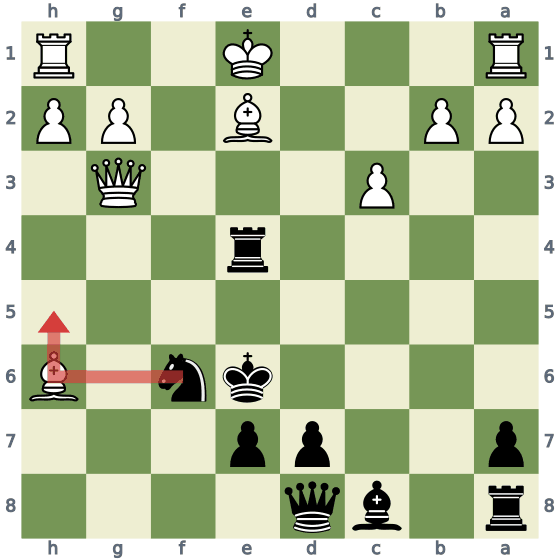
Rated 541 · Lichess Rapid 10+0 · move 22
Black played 22...Nh5, a blunder that left them losing. Find a better move.
Find the better move →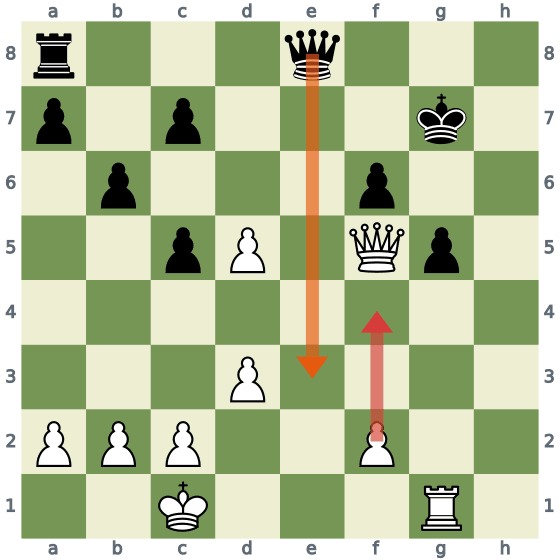
Rated 890 · Lichess Blitz 3+2 · move 24
White played 24.f4 and walked into a fork: Black answered Qe3+, and the win chance went from 84% to 5%. White went on to lose.
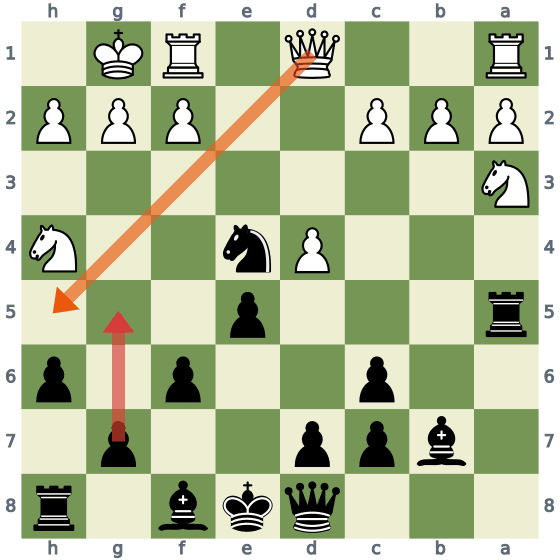
Rated 525 · Lichess Rapid 10+0 · move 13
Black played 13...g5 and walked into a fork: White answered Qh5+, and the win chance went from 76% to 19%. Black went on to lose.
Positions from the sampled games, shown from the player's side. The red arrow is the move played, the orange arrow the reply that punished it; a link opens the position on the board, where the site tells you whether you found the better move.
From 1000 to 1400:
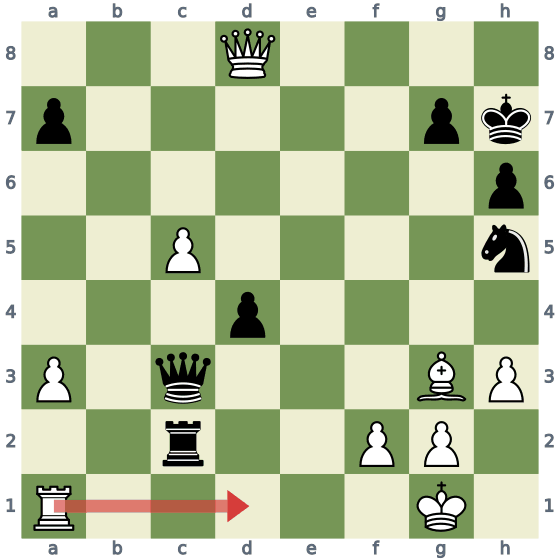
Rated 1392 · Lichess Rapid 10+0 · move 28
White played 28.Rd1, a blunder that left them losing. They went on to lose that game. Find a better move.
Find the better move →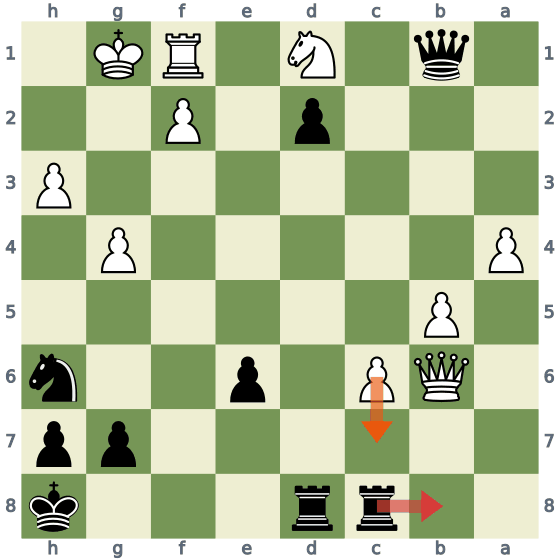
Rated 1436 · Lichess Blitz 5+3 · move 31
Black played 31...Rb8 and walked into a fork: White answered c7, and the win chance went from 80% to 11%. Black went on to lose.
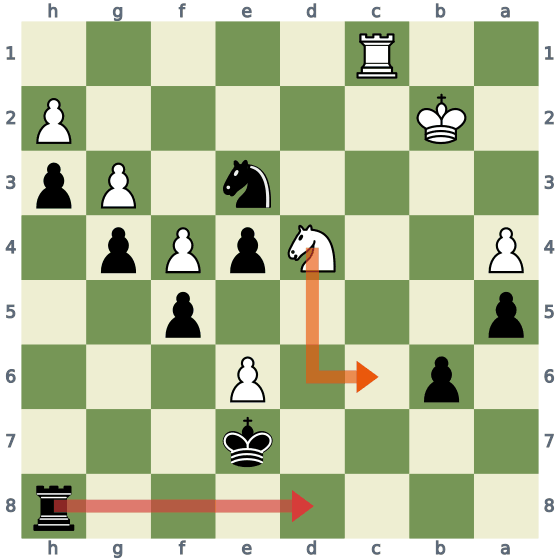
Rated 1072 · Lichess Rapid 10+0 · move 31
Black played 31...Rd8 and walked into a fork: White answered Nc6+, and the win chance went from 74% to 14%. Black went on to lose.
Positions from the sampled games, shown from the player's side. The red arrow is the move played, the orange arrow the reply that punished it; a link opens the position on the board, where the site tells you whether you found the better move.
From 1600 and above:
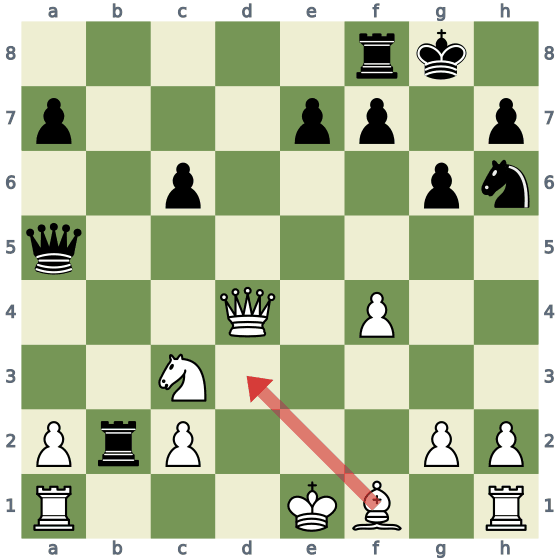
Rated 2503 · Lichess Blitz 3+2 · move 17
White played 17.Bd3, a blunder that threw away their advantage. They went on to lose that game. Find a better move.
Find the better move →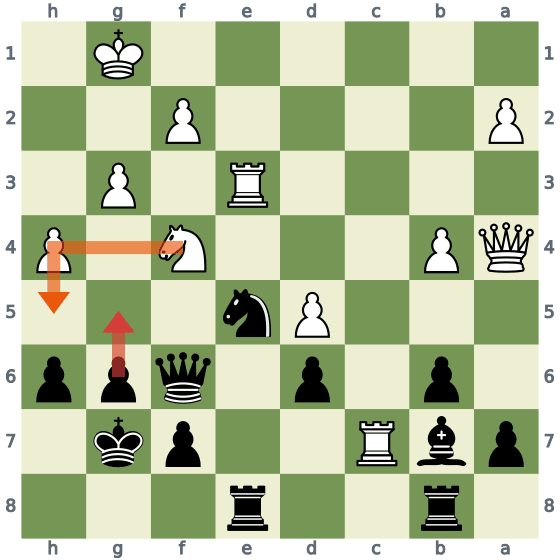
Rated 1777 · Lichess Blitz 3+0 · move 23
Black played 23...g5 and walked into a fork: White answered Nh5+, and the win chance went from 82% to 10%. Black went on to lose.
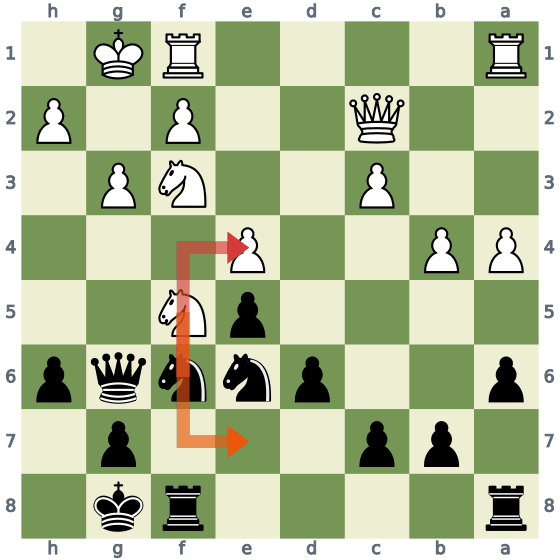
Rated 2466 · Lichess Blitz 3+0 · move 22
Black played 22...Nxe4 and walked into a fork: White answered Ne7+, and the win chance went from 54% to 8%. Black went on to lose.
Positions from the sampled games, shown from the player's side. The red arrow is the move played, the orange arrow the reply that punished it; a link opens the position on the board, where the site tells you whether you found the better move.
The check that catches them
Before you move: which of their pieces can give check next move, and what else would that check hit?
36% of forks come with check, and a check is the one move you can't ignore, so it is the fork you can't get out of. Every knight check and every queen check within one move should be named before you play. Then the same question without check: what square can their knight reach that touches two of yours?
Keep the rook off the knight's squares.
The rook is the piece lost in 44% of forks because it is the piece that can't run from a knight and can't be defended by a pawn. Before a rook goes to an open file or the seventh rank, name the square a knight could reach in one move that attacks it and your king or queen. Rooks on the same color square as the knight, two squares apart, are the pattern.
Loose pieces get forked.
A fork wins material only when one target is undefended or worth more than the forking piece. Two defended minor pieces forked by a knight lose nothing. The habit that makes you fork-proof is the same one that stops hung pieces: at the end of every move, count your undefended pieces, and get it to zero or one.
What won't fix it on its own: fork puzzles. Puzzles train you to deliver forks, and 93% of what you miss is something else; they rarely ask whether your own move walks into one. Positions from your own games do ask it, because the question is always what to play instead of the move that got forked.
How often is it the fork?
The report counts every fork you walked into in your last 75 games on Chess.com or Lichess, which piece did it, what you lost, and whether you were ahead at the time, and gives you the positions to solve on the board. It also counts the forks you missed. Free, no card, just your username.
Related: how to stop hanging pieces · how to stop allowing checkmate · why you keep losing · Daily Blunder: forks.
Check your own games: free chess game analysis · free chess game review · chess blunder checker.
How it works
1. Give us a username
Chess.com or Lichess. No account to make, nothing to install.
2. We go through every move
Your last 75 games, looking for the moments that keep costing you.
3. See what they've been hiding
In your inbox in about 15 minutes, with the positions to solve on the board.
Questions
Why do I keep getting forked?
Because the fork was set up the move before, by your own piece landing on a square the opponent's knight or queen could hit together with something else. In 1,166 forks walked into in rated Lichess games, 32% were by a knight and 36% came with check; 85% were played with over a minute on the clock and 67% from a level or better position. It is a looking habit, not a time or a knowledge problem.
Which piece forks the most?
The knight, in 32% of forks walked into, then the queen (22%), the rook (14%), pawns (18%) and the bishop (11%). Below 1000 the queen is nearly level with the knight.
What piece do you usually lose to a fork?
A rook, 44% of the time; the queen 24%; a bishop 14%; a knight 14%. Rooks go because a knight fork of king and rook is the classic and the rook can't be defended by a pawn.
How do you avoid knight forks?
Before each move, name every square a knight of theirs can reach in one move and what it would attack from there, especially squares that give check. Keep your rooks and queen off squares a knight's move apart from your king on the same color, and keep your pieces defended: a fork of two defended pieces wins nothing.
Do fork puzzles help?
They train delivering forks, which is a different skill from not walking into them, and forks are 7% of club players' mistakes. Positions from your own games where you walked into one train the look that was missing, because the question is what to play instead.
Is it really free?
Yes. We're building a training tool around these reports and want honest feedback from real players. No card, no trial.
Do you need my password?
Never. Your games on Chess.com and Lichess are public; we read them through the sites' official APIs. We only need your username and an email to send the report to.
Find out how often it's the fork.
Free report from your last 75 games on Chess.com or Lichess, in your inbox in about 15 minutes.
Get my free report