Stuck at 1800 · from the data
Stuck at 1800? Here's what 1800-rated games actually show.
At 1800 a third of the mistakes are judgment calls the engine disagrees with, and the games are mostly three-minute blitz. But the move that loses is still, two times in three, a piece left to be taken or a threat walked into. Here is what 1700 to 1900 games actually contain, counted move by move.
1,077 player-games rated 1700 to 1900, Lichess blitz and rapid, October 2026
What a 1800 game looks like
1,077 player-games by players rated 1700 to 1900: 36 moves a game, 2.1 blunders a game, 77% of player-games with at least one, accuracy 87.8, 0.58 blunders per ten moves (a third below 1200's 0.79). 15% of player-games were lost from a winning position, about the same as at 1500 (17%). The most common time control in the band is 3+0: 451 of the 1,043 games here, with 5+0 next.
The mix is the 1500 mix, pushed further. Judgment is 33% of mistakes, missed threats 32%, hung pieces 16%, missed wins 18%. The loose pawn is the largest tactical category (13.9% of mistakes), well ahead of the hanging piece (11.0%). But look at which mistake lost the game rather than which was most common: of the 502 losses with a decisive mistake, 26% were lost to a hung piece and 30% to a threat walked into. Judgment decided 15%. The common mistake at 1800 is positional; the losing one is still tactical.
The three mistakes that decide 1800 games
The report sorts every mistake by what went wrong. At 1800: 32% walked into the opponent's threat, 16% hung a piece, 18% missed a win, 2.3% allowed a mate, and 33% were judgment calls with no material in the line. The first three can be practiced from positions; here they are, with real ones from the sample.
Their threat, missed
32% of mistakes walked into the opponent's idea, and it is the biggest cause of lost games at 1800 (30% of decisive mistakes): a loose pawn (13.9% of all mistakes), a pin or skewer (6.2%), a trade counted wrong (7.5%), a fork (6.2%), a mate (4.5%), a discovered attack (3.1%). The opponent's ideas are two moves deep now, and the pawn that falls is the one the move you played stopped defending.
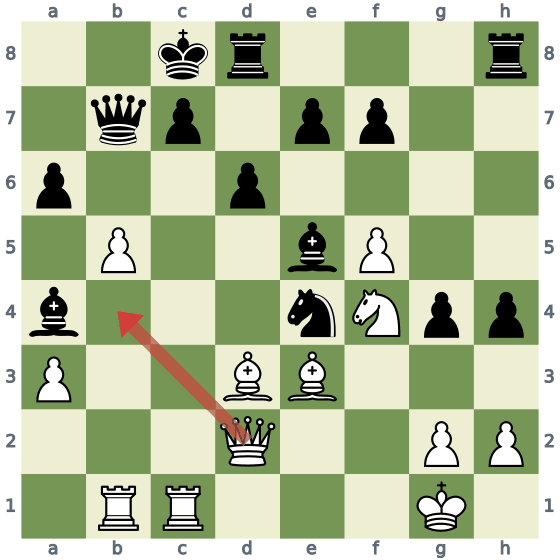
Rated 1934 · Lichess Blitz 3+0 · move 28
White played 28.Qb4, a blunder that turned a winning game into a losing one. Find a better move.
Find the better move →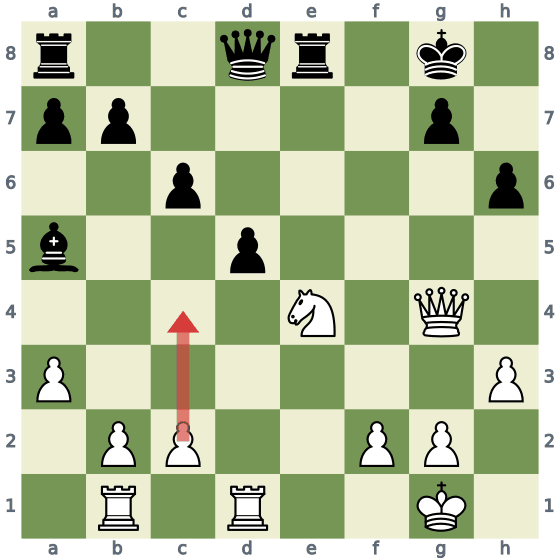
Rated 1984 · Lichess Blitz 3+0 · move 22
White played 22.c4, a blunder that left them losing. They went on to lose that game. Find a better move.
Find the better move →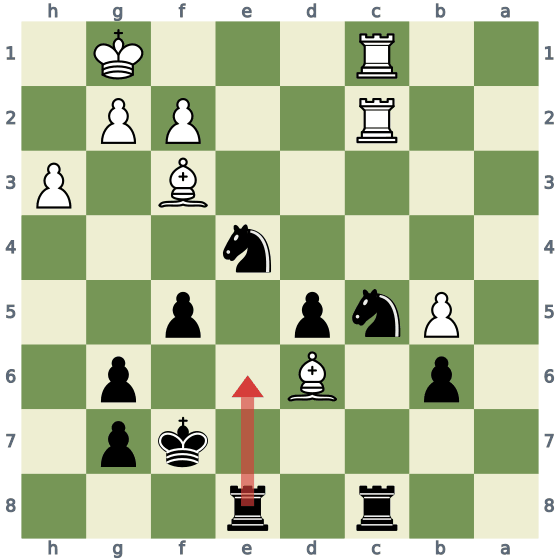
Rated 1898 · Lichess Rapid 10+0 · move 34
Black played 34...Re6, but there was a winning move. Find it.
Find the better move →Positions from the sampled games, shown from the player's side. The red arrow is the move played; a link opens the position on the board, where the site tells you whether you found the better move.
Pieces left to be taken
0.47 a game, 11% of mistakes, but 26% of the moves that lost a game. The rook (26% of hung pieces) and the queen (26%) lead. 79% were played with more than a minute on the clock, so it is not the blitz clock: 37% came between moves 11 and 20, in the part of the game where an 1800 is still playing from memory.
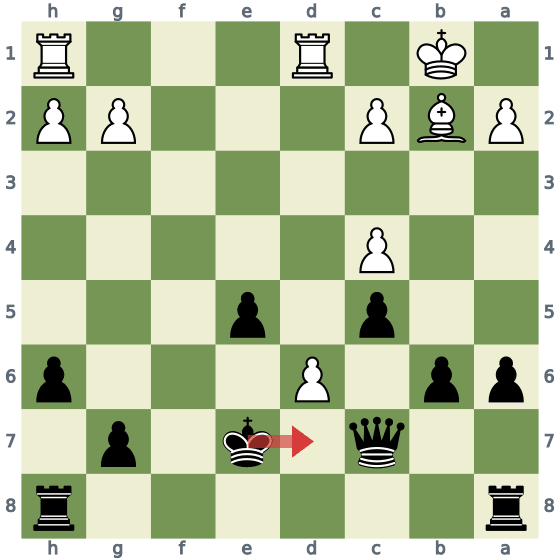
Rated 1852 · Lichess Blitz 3+0 · move 26
Black played 26...Kd7, a blunder that turned a winning game into a losing one. They went on to lose that game. Find a better move.
Find the better move →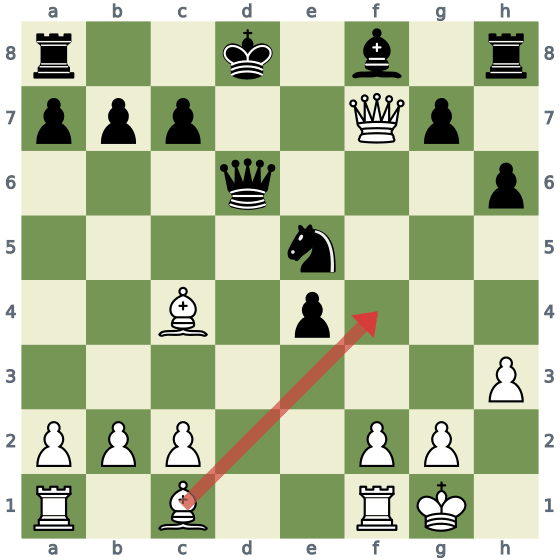
Rated 1868 · Lichess Blitz 3+0 · move 17
White played 17.Bf4, a blunder that turned a winning game into a losing one. They went on to lose that game. Find a better move.
Find the better move →Positions from the sampled games, shown from the player's side. The red arrow is the move played; a link opens the position on the board, where the site tells you whether you found the better move.
The win that was there
18% of mistakes were a win not taken: a tactic (13.7%), a free piece (1.7%), a mate (2.1%). Missed wins at 1800 are a sacrifice, an in-between move or a quiet move; the free piece is rare, and mate in one almost never gets missed.
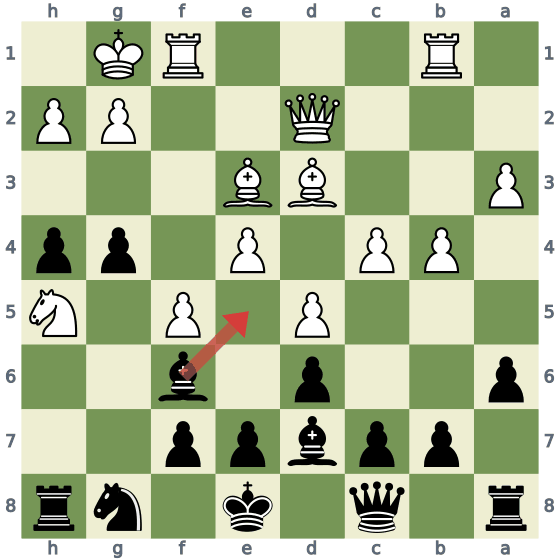
Positions from the sampled games, shown from the player's side. The red arrow is the move played; a link opens the position on the board, where the site tells you whether you found the better move.
More to solve from this level: chess puzzles by rating, real blunders from the same games.
What to check before you move
Between moves 11 and 20: stop playing from memory.
37% of hung pieces at 1800 came between moves 11 and 20, with time on the clock. The opening is known, the hands are fast, and the piece that gets hung is the one developed to a square the opponent's last move attacked. One check per move once the book runs out: what did their last move change?
What did your move stop defending?
The loose pawn is the largest tactical category at 1800 (13.9% of mistakes), and the pin or skewer the next (6.2%). Both come from a piece leaving a square. Before the move, name what the piece was guarding and what line it was blocking.
Treat level positions as the dangerous ones.
49% of the moves that lost an 1800 game were played from a level position, more than from winning and better positions together (35%). At 1800 the won games mostly get won. The level ones are where the threat gets walked into.
The clock: 13% of 1800-rated blunders came with under 30 seconds left (9% at 1500), and 25% of blitz losses in the band ended on the clock (12% in rapid). That is a real share, and the time-losses page covers it; but 87% of blunders were played with time to think. And the 33% of mistakes that are judgment are the part to study with a book, a coach or your own annotated games; the tactical two thirds is the part that can be counted and practiced from your games.
What changes at the next level
From 1800 to 2000 the counts move less than you'd think: blunders a game 2.1 to 2.0, accuracy 87.8 to 88.6, and judgment 33% to 36%. The hung piece is what goes: 0.47 a game here, 0.39 at 2000, 0.24 at 2400 and above. At 2200 the clock takes over: 23% of blunders under 30 seconds, nearly double the share here. The whole table is in the mistakes-by-rating article, and the 1500 page is the step before this one.
The other levels: 800 · 1000 · 1200 · 1500 · 1800 · the full table · why you keep losing · how to stop hanging pieces · accuracy by rating.
Which one is yours?
These are averages over 1,077 player-games. Your last 75 have their own count, and it is usually lopsided: one of the three is most of your losses. Chess Triage runs the same engine checks over your recent games on Chess.com or Lichess, counts your mistakes by kind, tells you which one costs you most, and emails you the positions to solve on the board. Free, no card, just your username. The sample report is one player's in full.
Check your own games: free chess game analysis · free chess game review · chess blunder checker.
How it works
1. Give us a username
Chess.com or Lichess. No account to make, nothing to install.
2. We go through every move
Your last 75 games, looking for the moments that keep costing you.
3. See what they've been hiding
In your inbox in about 15 minutes, with the positions to solve on the board.
Questions
Why am I stuck at 1800 in chess?
In this sample the common mistake at 1800 is a judgment call (33% of mistakes) but the losing one is tactical: 56% of the moves that decided a lost game were a piece left to be taken or a threat walked into, most of them from a level position and with more than a minute on the clock. The loose pawn and the pin are the shapes to look for. The judgment share is where study of plans and endgames pays.
Is 1800 a good chess rating?
Yes: on Lichess an 1800 is better than 85% of this week's rated rapid players and 79% in blitz; on Chess.com an 1800 rapid is about the 99th percentile of members. The per-move blunder rate at 1800 (0.58 per ten moves) is a quarter below 1200's and under half of 400's.
How do I get from 1800 to 2000?
Hang fewer pieces: an 1800 hangs 0.47 a game, a 2000 0.39, and that is most of the difference in the counts. The hung pieces at 1800 come early (37% between moves 11 and 20) and with time on the clock, so the fix is a habit after the opening, not a faster hand. Then the loose pawns and pins (20.1% of mistakes together).
Do 1800-rated players still hang pieces?
Yes, 0.47 a game, 11% of all mistakes, and they decide 26% of lost games. A rook in 26% of them, the queen in 26%. 79% were played with more than a minute left.
Which games were counted?
1,077 player-games by players rated 1700 to 1900 on Lichess in October 2026, rated blitz and rapid, every move after move 10 checked by Stockfish with the report's settings. The decisive-mistake figures are from the 502 lost games in the band with a flagged mistake.
What percentile is a 1800 rating?
On Lichess, a 1800 rapid player is better than 85% of this week's rated players (79% in blitz); on Chess.com, a 1800 rapid is about the 99th percentile of members, because the two sites count different people and the same player is rated 300 to 400 points higher on Lichess. The percentiles page has every rating on both sites. The numbers on this page are Lichess ratings; Chess.com players should read the page for the band above theirs.
Is it really free?
Yes. We're building a training tool around these reports and want honest feedback from real players. No card, no trial.
Do you need my password?
Never. Your games on Chess.com and Lichess are public; we read them through the sites' official APIs. We only need your username and an email to send the report to.
Find out which of the three is yours.
Free report from your last 75 games on Chess.com or Lichess, in your inbox in about 15 minutes.
Get my free report