From the data
Opening, middlegame or endgame: where are games actually lost?
"Study endgames" and "it's all tactics in the middlegame" are both advice from people who didn't count. We took 11,436 player-games from a month of rated Lichess play, filed every move after move 10 under the phase it was played in, using the report's own rule, and then filed every mistake the same way. The answer depends on your rating more than on the phase, and the endgame is not where you think.
First, where the moves are
The phase rule is the report's: an endgame is a position with the queens off and six or fewer pieces besides pawns and kings, or four or fewer with queens on; the opening is move 12 or earlier with most pieces still on the board; everything else is the middlegame. The report skips the first ten moves, so the "opening" column below is moves 11 and 12 only, and the opening proper gets its own section further down.
| Rating | Reached an endgame | Opening (moves 11 and 12) | Middlegame | Endgame | Moves a game |
|---|---|---|---|---|---|
| 400 | 33% | 9% | 59% | 32% | 26 |
| 600 | 35% | 10% | 58% | 33% | 26 |
| 800 | 41% | 9% | 54% | 38% | 29 |
| 1000 | 45% | 8% | 56% | 36% | 31 |
| 1200 | 49% | 8% | 56% | 36% | 33 |
| 1400 | 49% | 8% | 56% | 36% | 33 |
| 1600 | 54% | 7% | 57% | 36% | 36 |
| 1800 | 53% | 7% | 57% | 36% | 36 |
| 2000 | 59% | 7% | 57% | 36% | 39 |
| 2200 | 58% | 6% | 56% | 37% | 41 |
| 2400+ | 67% | 5% | 46% | 49% | 50 |
Share of each band's player-games that reached an endgame at any point, and the share of the player's judged moves (after move 10) played in each phase.
At 400, 67% of games never reach an endgame: they are over in the middlegame, usually by mate or resignation after a piece goes. At 2400 and above, 67% do, and 49% of the moves played are endgame moves. Between those, the share of moves played in the endgame sits at a third from 800 to 2000 and the share of games that get there climbs steadily. So the first answer to "should I study endgames" is a question back: do your games have any? Below 1000, two in three don't.
Where the mistakes are, per move played
Counting mistakes by phase without counting the moves in each phase gives the middlegame the blame for being long. Per ten moves played, the picture is different, and it is the same at every rating.
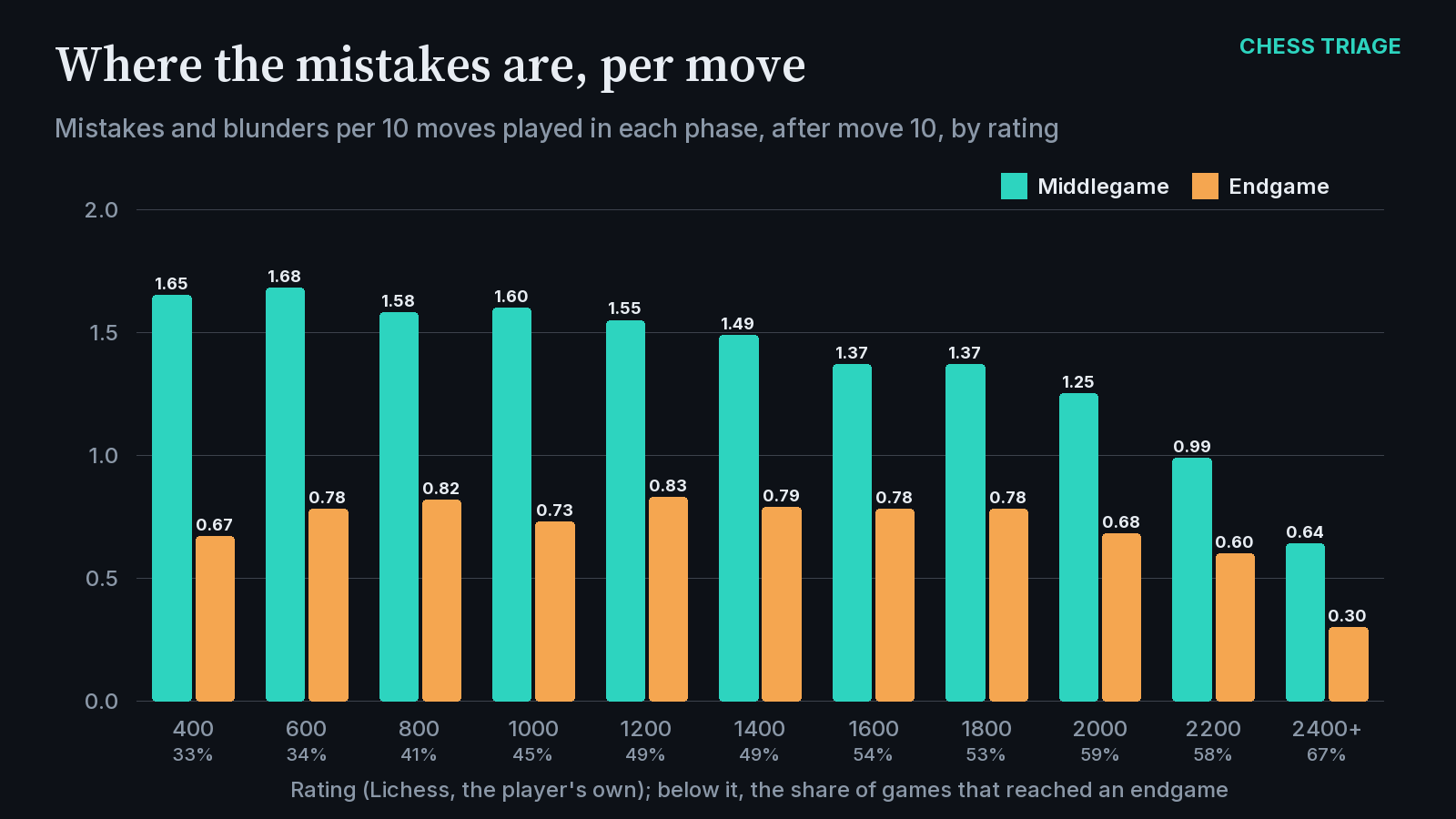
| Rating | Middlegame, per 10 moves | Endgame, per 10 moves | Middlegame to endgame | Endgame blunders per 10 | Share of mistakes in the endgame |
|---|---|---|---|---|---|
| 400 | 1.65 | 0.67 | 2.5x | 0.53 | 15% |
| 600 | 1.68 | 0.78 | 2.2x | 0.59 | 18% |
| 800 | 1.58 | 0.82 | 1.9x | 0.63 | 23% |
| 1000 | 1.60 | 0.73 | 2.2x | 0.53 | 20% |
| 1200 | 1.55 | 0.83 | 1.9x | 0.59 | 23% |
| 1400 | 1.49 | 0.79 | 1.9x | 0.55 | 23% |
| 1600 | 1.37 | 0.78 | 1.8x | 0.57 | 24% |
| 1800 | 1.37 | 0.78 | 1.8x | 0.56 | 25% |
| 2000 | 1.25 | 0.68 | 1.8x | 0.50 | 24% |
| 2200 | 0.99 | 0.60 | 1.7x | 0.41 | 27% |
| 2400+ | 0.64 | 0.30 | 2.1x | 0.20 | 32% |
Mistakes (10 or more win-chance points) per 10 of the player's own moves in each phase; blunders are 15 points or more. The last column is the plain share of the band's mistakes that were endgame mistakes, without adjusting for moves played.
In every band the endgame has fewer mistakes per move than the middlegame, roughly half: 2.5 times fewer at 400, 1.9 at 1200, 1.8 at 1800, 2.1 at 2400. There are fewer pieces, so fewer things to hang and fewer threats to miss; and the engine's win-chance scale is less jumpy when the material is small. The plain share tells the opposite story if you let it: 32% of a 2400's mistakes are in the endgame, against 15% of a 400's. That is because the 2400 plays half their moves there, not because the endgame is where they go wrong.
The rating gradient is steepest at the start. Mistakes per ten moves on moves 11 and 12 run from 2.21 at 400 to 0.37 at 2400, a factor of 6; the middlegame rate falls by a factor of 2.6 over the same range and the endgame rate by 2.2. Opening knowledge is the thing that separates the bands most, per move; it is just a small number of moves.
The opening, which the count skips
The report does not judge the first ten moves, on purpose: an engine's opinion of move 6 is not useful to a 900, and the report's thresholds would flag theory. But the games tell us what the opening did anyway. Of the lost games in the sample with no flagged mistake after move 10, 80% were already lost, or over, by move 10. Put that against the share of losses with no flagged mistake and the share of all losses decided before the count starts is 39% at 400, 30% at 600, 21% at 800, 15% at 1000, 11% at 1200, 9% at 1400 and 7% or less from 1600 up. The why-you-keep-losing page has what those early losses were (a piece hung on move 4 to 8, a scholar's mate, a queen trapped).
So below 1000 the opening is a real cause of lost games, in the plainest way: the piece was gone before the game started. From 1200 up it almost never is. The 1200 who wants an opening repertoire is buying something the data says they don't yet lose games for.
What changes in the endgame
Fewer mistakes per move, but a different kind, made by a different player.
| Mistake type | Middlegame | Endgame |
|---|---|---|
| Hung a piece | 21% | 15% |
| Missed their threat | 30% | 34% |
| Allowed mate | 3% | 3% |
| Missed a tactic | 15% | 11% |
| Missed mate | 3% | 6% |
| Missed a free piece | 3% | 2% |
| Judgment | 26% | 30% |
Share of each phase's mistakes by the report's type, all ratings.
Hung pieces fall from 21% of middlegame mistakes to 15% in the endgame; there is less to hang. Missed mates go the other way, 3% to 6%, because the endgame is where the mates are: a king in the open, a queen or a rook, and a mate in one or two that the player with the extra material walks past. Missed threats are the largest type in both phases, and in the endgame they are the pawn race counted wrong, the king walk not seen, the rook left where the new queen checks it.
And the player who errs is the one who was winning. 36% of endgame mistakes were made from a winning position (a win chance of 75% or more), against 27% in the middlegame; below 1000 it is 44%. That is the shape of the endgame mistake at club level: it is not a lost endgame played badly, it is a won one given back. The thrown-wins piece counted how often that ends in a lost game.
The clock is an endgame problem, in blitz
In blitz, 36% of endgame blunders were played with under 30 seconds left, against 9% of middlegame blunders. In rapid the figures are 4% and 0.5%. By rating, the share of endgame blunders under 30 seconds goes 17% at 800, 23% at 1200, 27% at 1800, 48% at 2200, 65% at 2400. Above 2000 the endgame is mostly played in time trouble and that, not technique, is what the endgame blunders are made of. The losing-on-time page counts the games that end on the flag itself.
Where the losses are decided
| Rating | Lost games decided in the endgame | Games with an endgame mistake | Lost by move 10 (est.) |
|---|---|---|---|
| 400 | 8% | 12% | 39% |
| 600 | 13% | 14% | 30% |
| 800 | 15% | 18% | 21% |
| 1000 | 17% | 20% | 15% |
| 1200 | 19% | 24% | 11% |
| 1400 | 21% | 25% | 9% |
| 1600 | 22% | 26% | 7% |
| 1800 | 20% | 27% | 6% |
| 2000 | 25% | 30% | 4% |
| 2200 | 25% | 28% | 3% |
| 2400+ | 30% | 24% | 2% |
The decisive mistake is the player's biggest drop in winning chance in a lost game; the first column is the share of those that were endgame moves. The last column is the estimate above: losses with no flagged mistake that were already lost or over by move 10.
Taking the move that lost each game, the endgame decided 8% of losses at 400, 17% at 1000, 22% at 1600, 25% at 2000 and 30% at 2400 and above. The middlegame decided most of the rest at every level. The curve is the one from the first table: the endgame decides games in proportion to how often the games get there.
What to do with this, by rating
Below 1000. 64% of your games never reach an endgame and 21% to 39% of your losses are decided before move 11. The work is the middlegame habit (what can they take?) and ten moves of opening safety: develop, castle, don't bring the queen out to be chased. Endgame study can wait; king-and-pawn basics are enough.
1000 to 1600. Half your games reach an endgame, you make half as many mistakes per move there as in the middlegame, and the ones you make are made while winning (36% of them). The endgame work that pays here is conversion: trade when ahead, push the passed pawn, find the mate with the extra piece. That is technique in the narrow sense and it is learnable in a week. The middlegame is still where 81% of your losses are decided.
1800 and up. 58% of games reach an endgame, 24% of losses are decided there, and in blitz 38% of your endgame blunders are played in the last 30 seconds. Endgame knowledge matters here and so does arriving at the endgame with time to use it. The blitz-versus-rapid page has what the clock does to the same players.
The report files every mistake in your last 75 games by phase as well as by kind, so you can see which of these three you are. It also gives you the positions, from your own endgames and middlegames, to solve on the board.
Check your own games: free chess game analysis · free chess game review · chess blunder checker.
Questions
Do most chess games reach an endgame?
About half, at club level: 49% of 11,436 rated Lichess player-games in this sample reached a position with the queens off and six or fewer pieces, or four or fewer with queens on. It depends on rating: 33% at 400, 49% at 1200, 59% at 2000, 67% at 2400 and above.
Where do beginners lose chess games, the opening, middlegame or endgame?
The middlegame, mostly, and the opening more than at any other level. At 400, the decisive mistake of a lost game was an endgame move 8% of the time, and roughly 39% of losses were already decided by move 10 (a piece gone, a quick mate). Hung pieces in the middlegame are the rest.
Are endgame blunders a time-trouble problem?
In blitz, largely: 36% of endgame blunders in blitz games were played with under 30 seconds left, against 9% of middlegame blunders. In rapid, 4%. Above 2000 the endgame is mostly played in time trouble; below 1200 it almost never is.
Should I study endgames at 1000?
Conversion, yes; theory, not yet. At 1000 to 1400, 48% of games reach an endgame, you make about half as many mistakes per move there as in the middlegame, and 36% of the endgame mistakes you do make are made from a winning position. Trading when ahead, pushing the passed pawn and mating with the extra piece covers most of it. The middlegame still decides 81% of your losses.
Which games were counted?
11,436 player-games from the Lichess open database for October 2026, rated blitz and rapid, 600 or more in every 200-point band from 400 to 2400 and above, each player counted under their own rating. Every move after move 10 was checked by Stockfish with the report's settings and filed under the phase of the position it was played from, using the report's phase rule. The first ten moves are not judged; the estimate for losses decided by move 10 comes from evaluating move 10 in the lost games that had no flagged mistake.
How we counted
Rated blitz and rapid games from the Lichess open database for October 2026, both players in each game: 5,718 games, 11,436 player-games, 600 games or more in every 200-point band from 400 to 2400 and above, each player counted under their own rating. Every move after the first ten was run through Stockfish at the same depth the report uses. A blunder is a move that cost 15 or more points of winning chance, a mistake 10 or more (Lichess's thresholds). The types are the report's own: a hung piece is one the opponent could simply take; a missed threat is a move that let the opponent's tactic in; "judgment" is a mistake with no material change in the engine's lines. The decisive mistake of a lost game is the player's biggest drop in winning chance after move 10. For the lost games without one, the position after move 10 was evaluated separately. The full tables are in the mistakes-by-rating article. We have no stake in any site named here.