Why you keep losing · from the data
Why do I keep losing at chess?
Usually not for the reason you think. We took 5,364 lost games from a month of rated Lichess play, at every rating from 400 to 2400, and found the move that lost each one: the biggest drop in winning chance after move 10. Then we looked at what that move was, whether the player was ahead when they played it, and how much time was on the clock. Here is what loses games, by rating.
5,364 lost player-games out of 11,436, Lichess blitz and rapid, October 2026
What actually lost the game
Every lost game has a move the engine points at: the one that cost the most winning chance after the opening. On average it cost 40 points, from a position you could still have held to one you couldn't. The report sorts those moves by what went wrong, and across all ratings the answer is plain. 27% left a piece (or a pawn) to be taken for nothing. 27% walked into something the opponent had set up: a fork, a pin, a mate threat, a loose pawn. 7% allowed a mate. 13% had the win on the board, played something else, and lost the game later by smaller steps. 10% were judgment calls, a plan or a trade the engine disliked with no material changing hands. And 17% of lost games had no flagged mistake after move 10 at all, which mostly means the game was already decided before it.
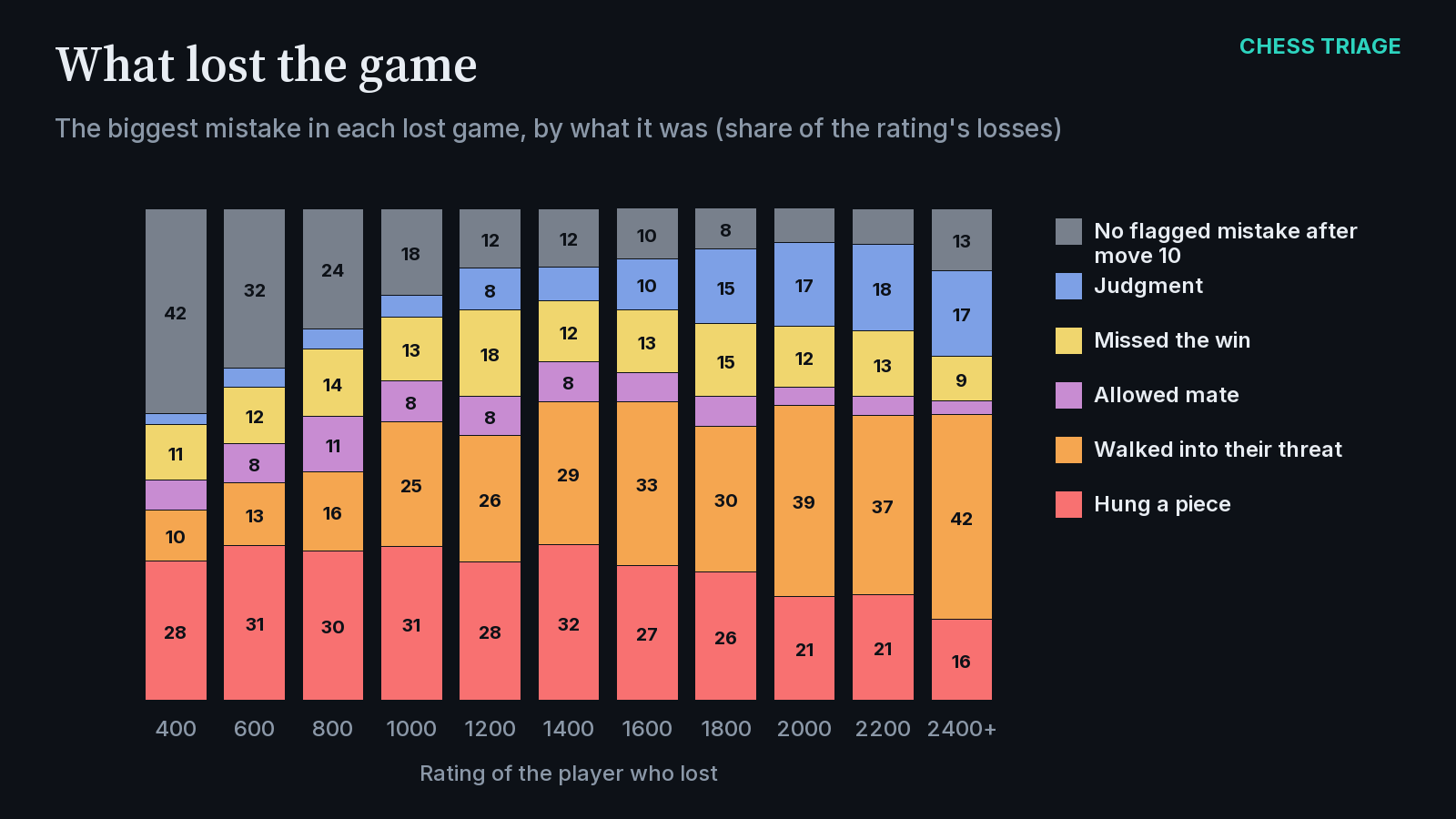
| Rating | Losses | Hung a piece | Walked into their threat | Allowed mate | Missed the win | Judgment | No flagged mistake |
|---|---|---|---|---|---|---|---|
| 400 | 452 | 28% | 10% | 6% | 11% | 2% | 42% |
| 600 | 529 | 31% | 13% | 8% | 12% | 4% | 33% |
| 800 | 508 | 30% | 16% | 11% | 14% | 4% | 24% |
| 1000 | 509 | 31% | 25% | 8% | 13% | 5% | 18% |
| 1200 | 501 | 28% | 26% | 8% | 18% | 8% | 12% |
| 1400 | 517 | 32% | 29% | 8% | 12% | 7% | 12% |
| 1600 | 506 | 27% | 33% | 6% | 13% | 10% | 10% |
| 1800 | 502 | 26% | 30% | 6% | 15% | 15% | 8% |
| 2000 | 539 | 21% | 39% | 4% | 12% | 17% | 7% |
| 2200 | 494 | 21% | 37% | 4% | 13% | 18% | 7% |
| 2400+ | 307 | 16% | 42% | 3% | 9% | 17% | 13% |
Share of the band's lost player-games by what the decisive mistake was. Missed the win: the biggest swing was a winning move not played; the game was lost afterward.
The last column needs explaining, because at 400 it is nearly half. We evaluated the position after move 10 in every one of those games. Across all ratings, 80% of them were already lost there or over before it; at 400 the figure is 94%, at 600 94%, at 800 87%. Below 800, in other words, a third to a half of losses are decided in the first ten moves: a queen trapped, a piece dropped on move 6, a quick mate. From 1000 upward the games get through the opening, and the column shrinks to the games that were ground down, resigned early, or lost on the clock without a bad move. The clock page counts those.
You were not losing when it happened
The losing move was rarely a last throw in a bad position. Of the decisive mistakes, 28% were played from a winning position (a 75% chance or better), 15% from a better one, 39% from level. Only 18% came when the player was already worse. At 400 to 600, 40% to 49% of losing moves were played while winning, usually with the opponent's piece already in hand; at 2000 and above it is under 22%, and about half of the losing moves come from a level game.
| Rating | While winning | While better | While level | While worse or lost | Lost games that had been winning | Under 30 s on the clock |
|---|---|---|---|---|---|---|
| 400 | 49% | 16% | 14% | 21% | 34% | 5% |
| 600 | 40% | 17% | 25% | 17% | 36% | 8% |
| 800 | 36% | 16% | 26% | 23% | 36% | 7% |
| 1000 | 32% | 19% | 33% | 16% | 38% | 7% |
| 1200 | 31% | 17% | 34% | 18% | 40% | 8% |
| 1400 | 28% | 18% | 39% | 15% | 38% | 11% |
| 1600 | 22% | 13% | 46% | 19% | 31% | 12% |
| 1800 | 22% | 13% | 49% | 16% | 33% | 15% |
| 2000 | 21% | 11% | 53% | 16% | 32% | 18% |
| 2200 | 20% | 9% | 48% | 23% | 24% | 20% |
| 2400+ | 15% | 12% | 53% | 20% | 20% | 34% |
The first four columns are shares of the band's decisive mistakes, by the player's winning chance before the move (winning 75% or more, better 60 to 75, level 40 to 60). Then: the share of the band's lost games in which the player was winning at some point after move 10, and the share of decisive mistakes played with under 30 seconds left.
And the clock was not the reason. 13% of decisive mistakes were played with under 30 seconds left; 80% had more than a minute. Below 1400 the under-30-second share never passes 8%. It rises with rating, to 12% at 1600 and 34% at 2400 and above, where the games are long and close and the clock decides them. If you are a club player, you are losing with time to think.
Where in the game: 69% of losing moves came in the middlegame, 48% of them on moves 11 to 20 and 31% on 21 to 30. The pieces are all out, the position is at its fullest, and that is when something gets left behind.
It is rarely one bad move
The lost games in the sample had 2.6 blunders in them, not one. 42% had three or more; only 9% had none. The won games had 1.9, and 68% of them had at least one. The difference between winning and losing at club level is not whether you blunder. Both players do, in most games. It is who blunders last, and how many times. In 68% of the games you lost, the opponent blundered too, which means the game was there to be had.
That reframes the question. "Why do I keep losing?" has a dull, useful answer: you make one more big mistake per game than the people who beat you, and it is nearly always one of two kinds. Cut your count by one and you win the games where the opponent also slipped, which is most of them.
What it looks like at your rating
400 to 800. The opening decides a third to a half of losses, and after it the loss is a hung piece (31% at 600, 30% at 800), most often the queen. Allowed mates are a real share here (11% at 800) and nowhere else. Nearly every losing move is played with over a minute on the clock. The 800 page has the positions.
1000 to 1400. The games get through the opening and two habits take over: a piece left to be taken (31% of losses at 1000, 32% at 1400) and a threat walked into (25% at 1000, 26% at 1200). Together they are six losses in ten. At 1200, 18% of losses had the win on the board first, the highest of any level, and 40% of lost games had been winning at some point. See 1000 and 1200.
1600 to 2000. Walking into the opponent's threat is now the biggest single cause (33% at 1600, 39% at 2000), hung pieces fall to 21% by 2000, and judgment (a plan or a trade, no material in the line) reaches 17%. The clock starts to matter: 12% of losing moves at 1600 come in the last 30 seconds. See 1500.
2200 and above. 42% of losses at 2400 and above are a missed threat, 16% a hung piece, and 34% of losing moves are played under 30 seconds. 53% come from a level position. This is where chess stops being about one habit.
What to do about it
The data points at three checks, one per cause, and says which one matters at your level.
Before you move: what can they take? After you have chosen a move and before you play it, look at the square the piece lands on and the square it leaves. Which of their pieces attacks each? What was the piece defending? Then every capture they have on the board. This is the hung-piece check, and it is the largest cause of losses from 600 to 1400. The hanging pieces page shows when it fails.
Before you plan: what did their last move change? Every move attacks something new, uncovers something, or stops defending something. Name it before you think about your own idea. This is the missed-threat check, the biggest cause from 1600 up and a third of losses at 1000. Forks and pins on your undefended pieces are most of it.
When you are winning: the simplest win. 28% of losing moves were played from a winning position. With a piece up, trade pieces, not pawns; keep your pieces defended; make the move you can't lose with before the move you might win faster with. The thrown-wins article has the numbers over 935,000 games.
What the data says won't help much: more opening study above 1000, because the opening decides 15% of losses at 1000 and 9% at 1400; and playing slower, because 87% of losing moves already had more than 30 seconds behind them. Below 800, the opening does matter: get to move 10 with your queen on the board and your king safe, and you have removed a third of your losses.
Which one is yours?
These are averages over 5,364 losses. Yours are lopsided: for most players one cause is half their losses, and it is usually not the one they would have guessed. Chess Triage runs the same checks over your last 75 games on Chess.com or Lichess, finds the move that lost each game, counts them by kind, tells you which one costs you most, and emails you the positions to solve on the board. Free, no card, just your username. The sample report is one player's in full.
Related: chess mistakes by rating · losing on time · blitz against rapid · accuracy by rating.
Check your own games: free chess game analysis · free chess game review · chess blunder checker.
How it works
1. Give us a username
Chess.com or Lichess. No account to make, nothing to install.
2. We go through every move
Your last 75 games, looking for the moments that keep costing you.
3. See what they've been hiding
In your inbox in about 15 minutes, with the positions to solve on the board.
Questions
Why do I keep losing at chess?
In 5,364 rated Lichess losses, the move that lost the game was a piece left to be taken in 27% of them and a threat walked into in 27%. 82% of those moves were played while level or ahead, and 87% with more than 30 seconds on the clock. Most players lose to one of those two habits, with time to think, from a position that was fine.
Why do I keep losing games I was winning?
Because the winning position made the check feel unnecessary. 28% of losing moves were played from a winning position, and at 1200 40% of lost games had been won at some point after move 10. The fix is the same look at their captures and their threats, kept up after you are ahead, plus trading pieces rather than pawns when you have the extra piece.
Am I losing because of time pressure?
Probably not, if you are rated under 1600. 13% of decisive mistakes across all ratings came with under 30 seconds left, and below 1400 the share is under 9%. Above 2000 the clock decides a real share of games (34% of losing moves at 2400 and above). Losses by time forfeit, where no bad move was needed, are counted on the losing on time page.
Is it my openings?
Below 800, often: 42% of losses at 400 and 33% at 600 had no flagged mistake after move 10, and 94% of those games were already lost or over by then. From 1000 upward the games get through the opening: the opening decides about 15% of losses at 1000 and 7% at 1600. Above 1000, the opening is rarely why you lost.
Why am I suddenly losing more than usual?
Most runs of losses are just runs: a player who wins half their games will lose five in a row about once every 30 games by chance alone. The count that tells you whether something changed is the one in your recent games, by kind. If the losing move is the same habit as before, nothing has changed except the dice; if it has moved to the clock, or to a new kind of position, that is the thing to look at.
Why do I lose to lower-rated players?
Because at club level both players blunder in most games (68% of won games had a blunder in them) and the result goes to whoever blunders last. A lower-rated opponent who gets one of your two habits for free wins the game; your rating comes from how often that happens over many games, not from any one of them.
Is it really free?
Yes. We're building a training tool around these reports and want honest feedback from real players. No card, no trial.
Do you need my password?
Never. Your games on Chess.com and Lichess are public; we read them through the sites' official APIs. We only need your username and an email to send the report to.
Find out what loses yours.
Free report from your last 75 games on Chess.com or Lichess, in your inbox in about 15 minutes.
Get my free report