Free, from your own Chess.com or Lichess games
Find your chess weaknesses from your last 75 games.
Not a quiz, not a rating test. We read every move of your last 75 games, count the mistakes that keep repeating, and tell you which ones are costing you games, with the positions to practice. Free, emailed in about 15 minutes.
A weakness is a mistake that repeats
Everyone hangs a piece sometimes. A weakness is the mistake that shows up in game after game: the rook you keep leaving loose, the knight fork you keep walking into, the back rank you keep forgetting. You can't see it in one game, and it's hard to see in your own, because in the moment each one felt like a one-off.
So the report counts. Every mistake and blunder in your last 75 games, sorted into 14 kinds, with the piece involved and whether you were ahead when you made it. Then it tells you which kind costs you most, in plain counts, and what to check before you move.
The 14 kinds of mistake it looks for
- Pieces left to be takenHanging pieces, loose pawns, and exchanges counted wrong: taking on a square where the opponent comes out ahead.
- Tactics you walk intoForks, pins and skewers, discovered attacks, double attacks, a defender removed, a piece chased into a trap.
- The kingMates allowed, mate threats missed (the opponent's, and your own), and checks that win material.
- The restSacrifices wrongly accepted or missed, and passed pawns that should have been pushed, stopped or blockaded.
Each kind has a page in the Daily Blunder archive with real examples from rated games.
The weakness that costs the most: won games
The biggest number in most reports is the games lost from a winning position. In the sample report: 16 lost and 4 drawn from winning, out of 75 games. Across the September Lichess database, one in five clearly won games was not won, and the way they go changes with rating: dropped queens at 600, missed threats at 1600, the clock at 2200. Your report shows you which moves did it in your games, and which of those ways is yours.
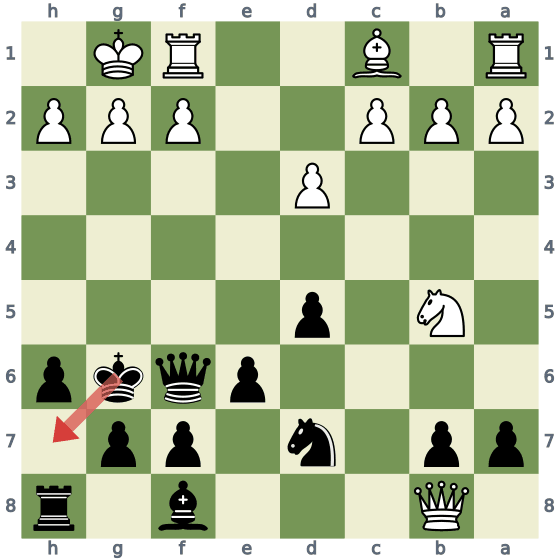
From the sample report · Hanging Piece
You played 17...Kh7, but there was a winning move. Find it.
See the whole report →What it doesn't cover
Openings, time management and positional judgment. The report is about the tactical mistakes an engine can point to on a single move, which is where players up to about 1800 lose most of their points. If you're stronger than that, you'll still get the counts and the positions, but more of your losses will come from decisions it doesn't see.
It also doesn't compare you with anyone. No percentile, no "players at your level". The report is your games, counted, and what to do about them.
Check your own games: free chess game analysis · free chess game review · chess blunder checker.
How it works
1. Give us a username
Chess.com or Lichess. No account to make, nothing to install.
2. We go through every move
Your last 75 games, looking for the moments that keep costing you.
3. See what they've been hiding
In your inbox in about 15 minutes, with the positions to solve on the board.
Questions
Is it really free?
Yes. We're building a training tool around these reports and want honest feedback from real players. No card, no trial.
How is this different from a quiz or a rating test?
A quiz asks you 15 puzzles and guesses. This reads the moves you actually played, in your last 75 games, and counts what went wrong. The weaknesses it finds are the ones in your games, not the ones a test happened to ask about.
How is this different from Chess.com Insights or Aimchess?
Those are paid (Insights needs a Diamond membership, Aimchess is a subscription) and lean on statistics and charts. This is free, needs no account, counts your mistakes by kind, and gives you the positions to solve. It doesn't cover openings or time management.
Will it tell me my real rating or compare me with other players?
No. The report is about your games only: what went wrong, how often, and the positions to practice. The population numbers live in our data articles, not in your report.
Who is it for?
Players from beginner to about 1800 get the most out of it: that's where tactical mistakes cost the most points. Stronger players get a full report too, but more of what they lose comes from positional choices the report doesn't cover.
What if I haven't played many games?
You need at least 10 rapid, blitz, classical or daily games. With fewer than 30, your report is a first look: there's less to count, but the positions are still yours to solve. Under 10, leave your email and we'll tell you once you've played enough.
Do you need my password?
Never. Your games on Chess.com and Lichess are public; we read them through the sites' official APIs. We only need your username and an email to send the report to.
Find out which mistake is yours.
Free report from your last 75 games, in your inbox in about 15 minutes.
Get my free report