Free chess blunder checker for Chess.com and Lichess
Find every blunder in your last 75 games.
Give us your username. We check every move of your last 75 games with a chess engine, count the blunders, sort them by what went wrong, and email you the positions to solve on the board. Free, in about 15 minutes.
What the checker finds
A blunder checker that reads one game tells you about one afternoon. This one reads 75, and three things come out of that which no single review can give you.
How many, and in how many games
From a real report: 146 blunders in 56 of 75 games. A blunder here is a move that cost 15 or more points of winning chance, by the engine's count. The same threshold in every game, so the count means the same thing from game to game and from report to report.
What kind
Every blunder is sorted by what went wrong: a hanging piece, a fork walked into, a pin or skewer, a mate allowed or missed, an exchange counted wrong, a loose pawn, and eight more. Then which piece you leave hanging most often. The same report: rooks 23 times, bishops 14.
When
Blunders made while level or ahead are the ones that lose games you should have won, so they're counted on their own. That report: 22 of 36 losses had a mistake or blunder made while level or ahead, and 16 games were lost from a winning position.
Then the positions themselves
A number tells you how often. The positions tell you what it looks like from your side of the board. The report picks the blunders worth practicing and shows each one just before the move you played, with your move as a red arrow. Find the better move, and the site tells you whether you have it, shows why your move failed, gives the engine's line, and lets you play the rest out.
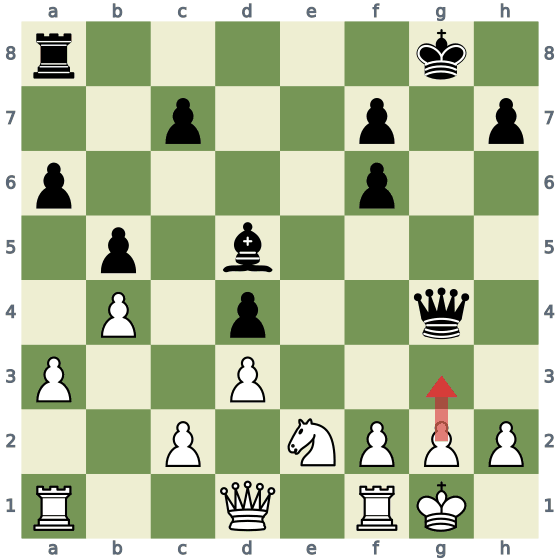
From the sample report · Their threat: Checkmate
You played 19.g3, a blunder that turned a winning game into a losing one. Find a better move.
See the whole report →Why 75 games and not one
One hanging rook is bad luck. Twenty-three is a habit, and a habit has a cure: a check you run before every move, aimed at the thing you actually get wrong. You can only see the habit when the blunders are counted together, and that's the part a one-game review leaves out.
For the game you just finished, Lichess's analysis and Chess.com's analysis board are free and quick, and we say so in our comparison of the free game review tools. This is the other thing: the pattern across your recent games, in your inbox, with the positions to fix it.
See also: free chess game analysis · free chess game review.
How it works
1. Give us a username
Chess.com or Lichess. No account to make, nothing to install.
2. We go through every move
Your last 75 games, looking for the moments that keep costing you.
3. See what they've been hiding
In your inbox in about 15 minutes, with the positions to solve on the board.
Questions
Is it really free?
Yes. We're building a training tool around these reports and want honest feedback from real players. No card, no trial.
Do I have to upload a PGN?
No. Give us your Chess.com or Lichess username and we fetch your recent games through the sites' official APIs. No password, no account, no file to find.
What counts as a blunder?
A move that cost you 15 or more points of winning chance, as judged by the engine at a fixed depth, with the positions that make it into the report checked again more deeply. Smaller slips are counted as mistakes. The same threshold applies in every game, so the counts in your report mean the same thing throughout.
Which games do you look at?
Your most recent rapid and blitz games against people, rated or casual, up to 75. If you have fewer than 30 of those, we add your classical and daily games. We skip bullet, games against bots, and Chess960 or games from a set-up position.
Can I check one particular game?
Not here. The report reads your most recent games together and doesn't review a single game you pick. For one game, Lichess's computer analysis is free (up to 40 games a day), and it takes a pasted PGN from Chess.com too.
How long does it take?
Your report usually arrives in about 15 minutes, at most 24 hours. Every game is analyzed move by move, and the positions in the report get a deeper second pass, so it isn't instant.
Do you need my password?
Never. Your games on Chess.com and Lichess are public; we read them through the sites' official APIs. We only need your username and an email to send the report to.
Find out what your blunders have in common.
Free report from your last 75 games, in your inbox in about 15 minutes.
Get my free report