Missed tactics · from the data
How to stop missing tactics.
You solve puzzles fine and still walk past the fork in your own games. That is not a puzzle problem: a puzzle tells you a tactic is there, and a game doesn't. We took every move in a month of rated Lichess games where a tactic, a mate or a free piece was on the board and the player played something else, 6,041 of them from 400 to 2400, and counted what was missed, whether the player was ahead, how much time they had, and whether it cost the game. Then the one habit that finds them.
6,041 missed wins in 11,436 player-games, Lichess blitz and rapid, October 2026
How often the win is there, and gets missed
A missed win here is the report's "missed a tactic", "missed mate" or "missed a free piece": a move where the engine had a forcing line that won material or mated, worth 10 or more points of winning chance, and the player played something else. Together they are 20% of all the mistakes in the sample, the third type after hung pieces and threats walked into. The rate per game is the striking thing: 0.63 at 400, 0.61 at 800, 0.55 at 1600, 0.49 at 2000, falling faster only at 2400 and above, to 0.31. Players get much better at not hanging pieces as they climb; they get only a little better at taking what is offered. What changes is how big the thing missed is.
| Rating | Missed wins | A game | Tactics | Mates | Free pieces | While winning | Over 1 min | Game still lost |
|---|---|---|---|---|---|---|---|---|
| 400 to 800 | 1,865 | 0.61 | 62% | 20% | 18% | 69% | 89% | 44% |
| 1000 to 1400 | 1,788 | 0.56 | 71% | 16% | 13% | 65% | 85% | 46% |
| 1600 and up | 2,388 | 0.46 | 79% | 13% | 8% | 61% | 70% | 43% |
| All | 6,041 | 0.53 | 72% | 16% | 12% | 65% | 80% | 44% |
Missed wins in each rating group: how many, per player-game, what kind (shares), the share missed from a winning position, the share played with more than a minute on the clock, and the share of games containing one that were lost anyway.
What gets missed
Tactics proper are 72% of the misses, mates 16%, and a piece that was simply free to take 12%. By the tactical category the report files them under: a hanging piece (yours to take) in 20% of missed wins, a checkmate in 16%, a fork in 11%, a loose pawn in 10%, a trade that wins material in 9%, a pin or skewer in 9%, a discovered attack in 5%. The two biggest categories are the two simplest: a piece free to take and a mate.
Below 1000, the missed wins are the plain ones: a free piece or a hanging piece in 44% of cases and a mate in 20%, and of the missed mates, 41% were mate in one. From 1600 up the free pieces are down to 8% and the mate-in-ones to 23% of missed mates; what gets missed there is a fork (11%), an exchange that wins (11%), a pin (9%): two moves deep, not one. 60% of all missed wins were a one-move win, the capture or the mate right there; 40% needed a check or a sacrifice first.
The cost is the same at every level. A missed win drops the player's winning chance by 29.6 points on average, 74% of them count as blunders, and 44% of the games that contained one were lost. Not because the miss lost the game on the spot, usually; because the game went on, and a game that goes on is a game the opponent can win.
When it happens: while winning, with time
65% of missed wins were missed from a winning position and another 15% from a better one. That is the opposite of the hung piece, which happens in level positions. The win gets missed because the player is already winning and has stopped looking for the move that ends it; they are trading down, or consolidating, or just moving. Below 1000 the share missed while winning is 69%, from 1600 up 61%.
And it is not the clock. 80% of missed wins were played with more than a minute on the clock, 89% below 1000, 85% from 1000 to 1400. Only above 2000, in three-minute blitz, does the last 30 seconds take a real share (26% at 2200, 36% at 2400). 71% happen in the middlegame and 21% in the endgame, where the missed mate with the extra queen lives.
What it looks like
Positions from the sampled games where the win was on the board and something else was played: first from players rated under 1000, then 1000 to 1400, then 1600 and above. Find the move that was missed; the page shows the game's move and what should have been played.
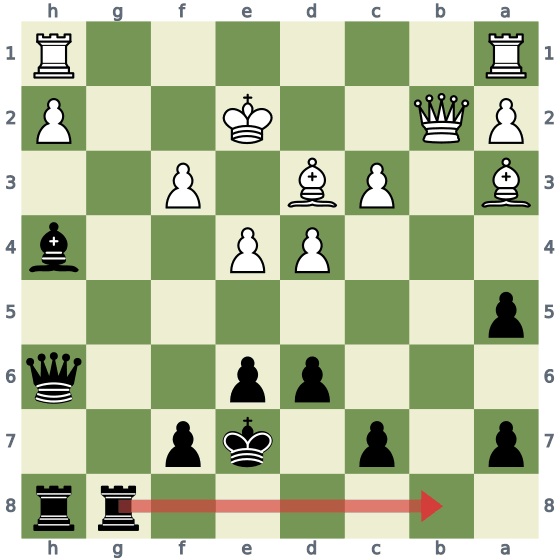
Rated 662 · Lichess Blitz 5+0 · move 39
Black played 39...Rb8, but there was a winning move. Find it.
Find the better move →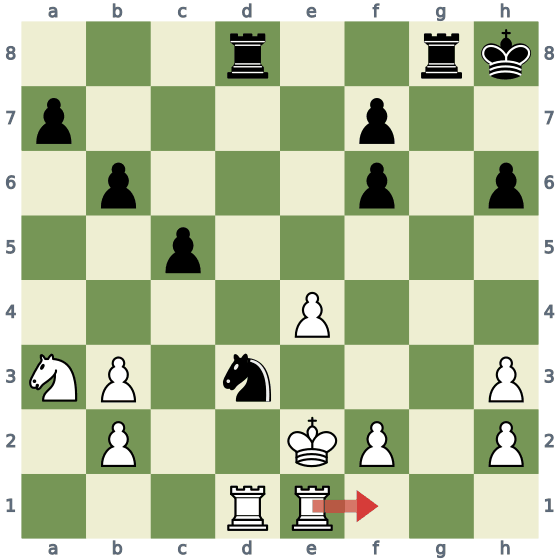
Rated 549 · Lichess Rapid 10+0 · move 31
White played 31.Rf1, but there was a winning move. Find it.
Find the better move →Positions from the sampled games, shown from the player's side. The red arrow is the move played; a link opens the position on the board, where the site tells you whether you found the better move.
From 1000 to 1400:
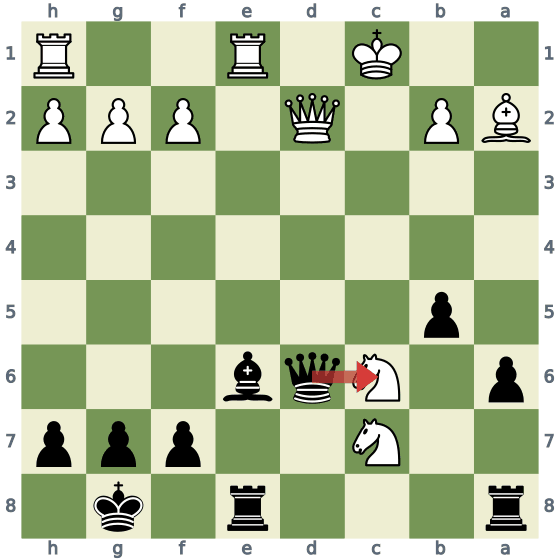
Rated 1207 · Lichess Rapid 10+0 · move 18
Black played 18...Qxc6+, but there was a much better move. Find it.
Find the better move →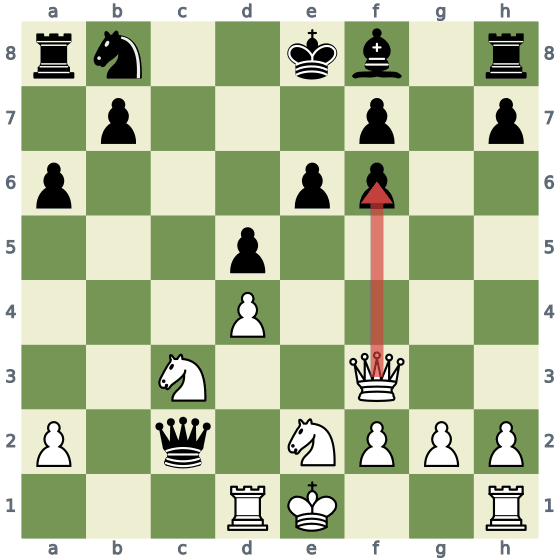
Rated 1030 · Lichess Rapid 10+0 · move 13
White played 13.Qxf6, but there was a winning move. Find it.
Find the better move →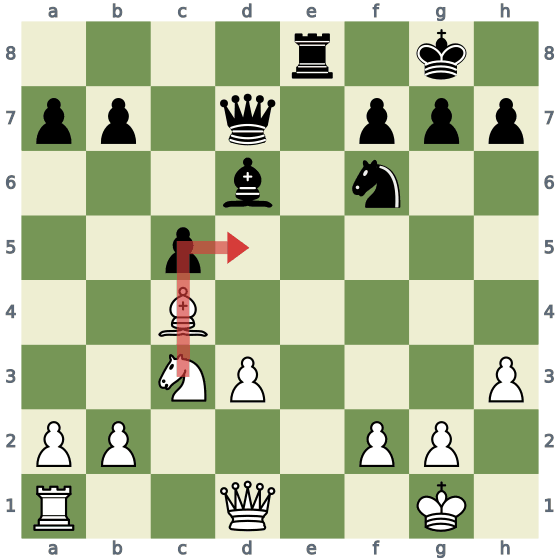
Rated 1147 · Lichess Rapid 10+0 · move 18
White played 18.Nd5, but there was a winning move. Find it.
Find the better move →Positions from the sampled games, shown from the player's side. The red arrow is the move played; a link opens the position on the board, where the site tells you whether you found the better move.
From 1600 and above:
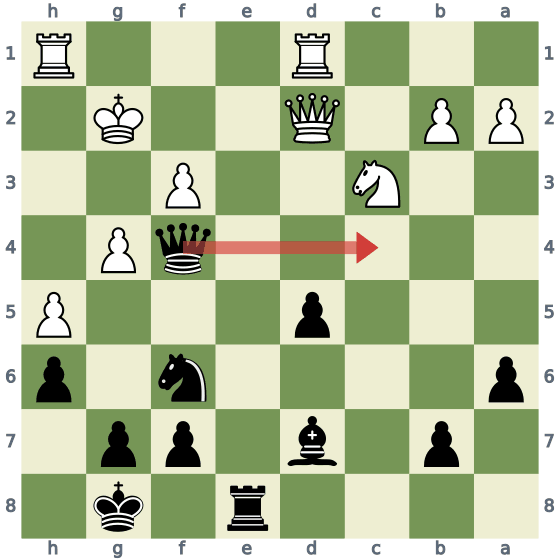
Rated 2404 · Lichess Blitz 3+0 · move 25
Black played 25...Qc4, but there was a winning move. Find it.
Find the better move →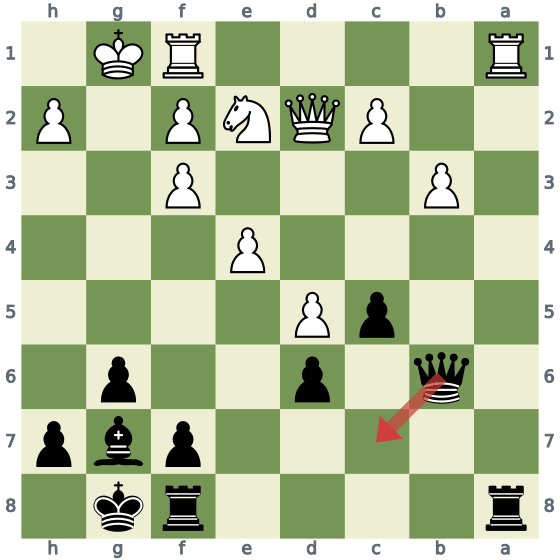
Rated 1606 · Lichess Blitz 5+0 · move 27
Black played 27...Qc7, a blunder that threw away their advantage. Find a better move.
Find the better move →Positions from the sampled games, shown from the player's side. The red arrow is the move played; a link opens the position on the board, where the site tells you whether you found the better move.
The habit that finds them
Checks, captures, threats. Every move. Especially when you're winning.
79% of missed wins were missed from a winning or better position. The scan that finds a tactic is three questions in a fixed order: can I give check, can I take something, can I attack something they can't defend. The order matters because the forcing moves come first. The habit breaks down exactly when you are ahead, so the rule is the opposite of instinct: when you are winning, look harder.
A free piece is a tactic. Count their undefended pieces too.
32% of missed wins were a piece simply free to take, or hanging to a capture. The same count that stops you hanging pieces (how many of mine are undefended?) works in reverse: how many of theirs are? Any number above zero is a capture to calculate before anything else.
When their king has two squares or fewer, look for mate before you look at anything else.
Mates are 16% of missed wins; below 1000, 41% of the missed mates were mate in one, and at 400 47%. A king with few flight squares is the signal; the scan is every check, and for each check, where does the king go. Thirty seconds of that is cheaper than the twenty moves that follow a missed mate.
What won't fix it on its own: more puzzles. Puzzles help with the pattern, and they are the one place in this data where puzzle training really does apply. But a puzzle announces itself, and a game move 23 does not: the skill that is missing is noticing that there is something to find. Positions from your own games, where the only clue is that you played something else, train the noticing, because that is the situation you were actually in.
How many wins do you walk past?
The report counts every tactic, mate and free piece you missed in your last 75 games on Chess.com or Lichess, whether you were ahead at the time, and what it cost, and gives you the positions to find them in on the board. Free, no card, just your username.
Related: how to stop hanging pieces · how to stop getting forked · how to stop allowing checkmate · one in five won games gets thrown away · the Daily Blunder.
Check your own games: free chess game analysis · free chess game review · chess blunder checker.
How it works
1. Give us a username
Chess.com or Lichess. No account to make, nothing to install.
2. We go through every move
Your last 75 games, looking for the moments that keep costing you.
3. See what they've been hiding
In your inbox in about 15 minutes, with the positions to solve on the board.
Questions
Why do I miss tactics in my games but solve them in puzzles?
Because a puzzle tells you there is a tactic and a game doesn't. In 6,041 missed wins from rated Lichess games, 65% were missed from a position the player was already winning and 80% with more than a minute on the clock: not a knowledge gap, not time, but not looking. The fix is a scan you run every move (checks, captures, threats), hardest to keep up exactly when you're ahead.
How often do chess players miss a winning tactic?
About once every two games, at every rating from 400 to 2000 (0.63 a game at 400, 0.58 at 1200, 0.49 at 2000; 0.31 at 2400 and above), counting tactics, mates and free pieces worth 10 or more points of winning chance. 33% of player-games contained at least one.
What is the most common missed tactic?
A piece that was free to take: a hanging piece or an undefended capture in 32% of missed wins. Then a checkmate (16%), a fork (11%), a loose pawn (10%), a trade that wins material (9%) and a pin or skewer (9%). At 400, 47% of the missed mates were mate in one; at 1600 and above, 23%.
Does missing a tactic lose the game?
Often enough. 44% of the games that contained a missed win were lost, and 31% of all lost games in the sample contained one. The miss drops the player's winning chance by 29.6 points on average; the game goes on, and the opponent gets their chances.
Do I miss tactics because of time pressure?
Rarely. 80% of missed wins were played with more than a minute left, and below 1400 about 89%. Only above 2000, in three-minute blitz, does the last 30 seconds account for a real share (26% at 2200).
Is it really free?
Yes. We're building a training tool around these reports and want honest feedback from real players. No card, no trial.
Do you need my password?
Never. Your games on Chess.com and Lichess are public; we read them through the sites' official APIs. We only need your username and an email to send the report to.
Find out how many wins you walk past.
Free report from your last 75 games on Chess.com or Lichess, in your inbox in about 15 minutes.
Get my free report