Hanging pieces · from the data
How to stop hanging pieces.
Everybody tells you to check whether your piece is safe. Nobody tells you when you're most likely to forget. We counted every hung piece in a month of rated Lichess games, at every rating: which piece, which move, how much time was on the clock. It is not a time-trouble problem, and it is not a beginner-only one.
11,436 player-games, 400 to 2400+, Lichess blitz and rapid, October 2026
How often pieces get hung
A hung piece here is the report's definition: a move after which the opponent could simply take a piece (or a pawn) for nothing, or for less than it was worth, and the engine's line says so. Not a fork, not a pin, not a trade that came out behind; those are counted separately. Just a piece left on a square it could be taken from.
Across the sample a player did it 0.52 times a game, and it was 20% of all mistakes and blunders. By rating: 0.71 a game at 400 and 0.68 at 600, 0.57 at 1200, 0.52 at 1600, 0.39 at 2000, 0.24 at 2400 and above. Per game the number is nearly flat from 400 to 1600, because the games get longer as the rate per move falls. As a share of mistakes it goes from 31% at 400 to 13% at 2400 and above: the strongest players in the sample still hang a piece in one game in four.
| Rating | Hung a game | Share of mistakes | Queen | Rook | Knight | Bishop | Pawn | Taken at once |
|---|---|---|---|---|---|---|---|---|
| 400 | 0.71 | 31% | 30% | 23% | 22% | 18% | 7% | 93% |
| 600 | 0.68 | 28% | 26% | 23% | 22% | 22% | 7% | 88% |
| 800 | 0.65 | 25% | 24% | 25% | 22% | 15% | 14% | 85% |
| 1000 | 0.58 | 21% | 26% | 23% | 22% | 17% | 12% | 82% |
| 1200 | 0.57 | 19% | 22% | 26% | 20% | 15% | 17% | 80% |
| 1400 | 0.57 | 20% | 22% | 27% | 18% | 15% | 19% | 75% |
| 1600 | 0.52 | 17% | 23% | 27% | 18% | 15% | 17% | 75% |
| 1800 | 0.47 | 16% | 26% | 26% | 16% | 15% | 16% | 74% |
| 2000 | 0.39 | 13% | 21% | 27% | 21% | 16% | 16% | 71% |
| 2200 | 0.36 | 14% | 20% | 30% | 17% | 17% | 17% | 72% |
| 2400+ | 0.24 | 13% | 19% | 32% | 17% | 13% | 19% | 76% |
The piece columns are shares of the band's hung pieces. Taken at once: the opponent's reply captured it.
Which piece changes with rating. At 400 it is the queen (30% of hung pieces); from 1200 up it is usually the rook, in a quarter to a third of cases. Pawns rise from 7% at 400 to 19% at 2400 and above, because by then the pieces are mostly looked after and the pawns aren't.
When it happens
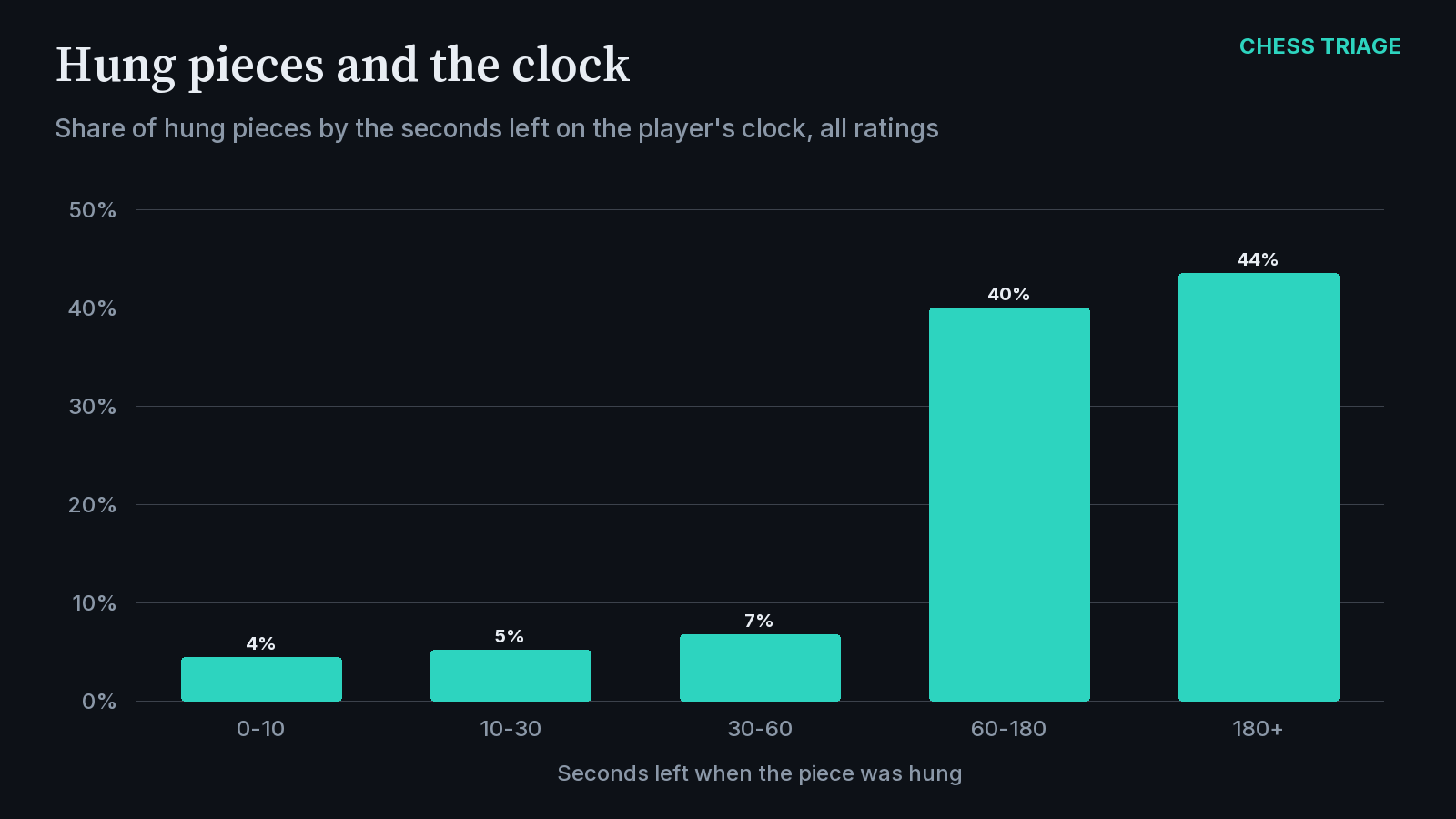
Not in time trouble. 44% of hung pieces were played with more than three minutes on the clock and another 40% with one to three. Under 30 seconds: 10%. Below 1200 the under-30-second share is 7% at 800 and 4% at 1000. The pieces are being hung with time to think, which is good news: a check you can do with time to think is a check you can learn.
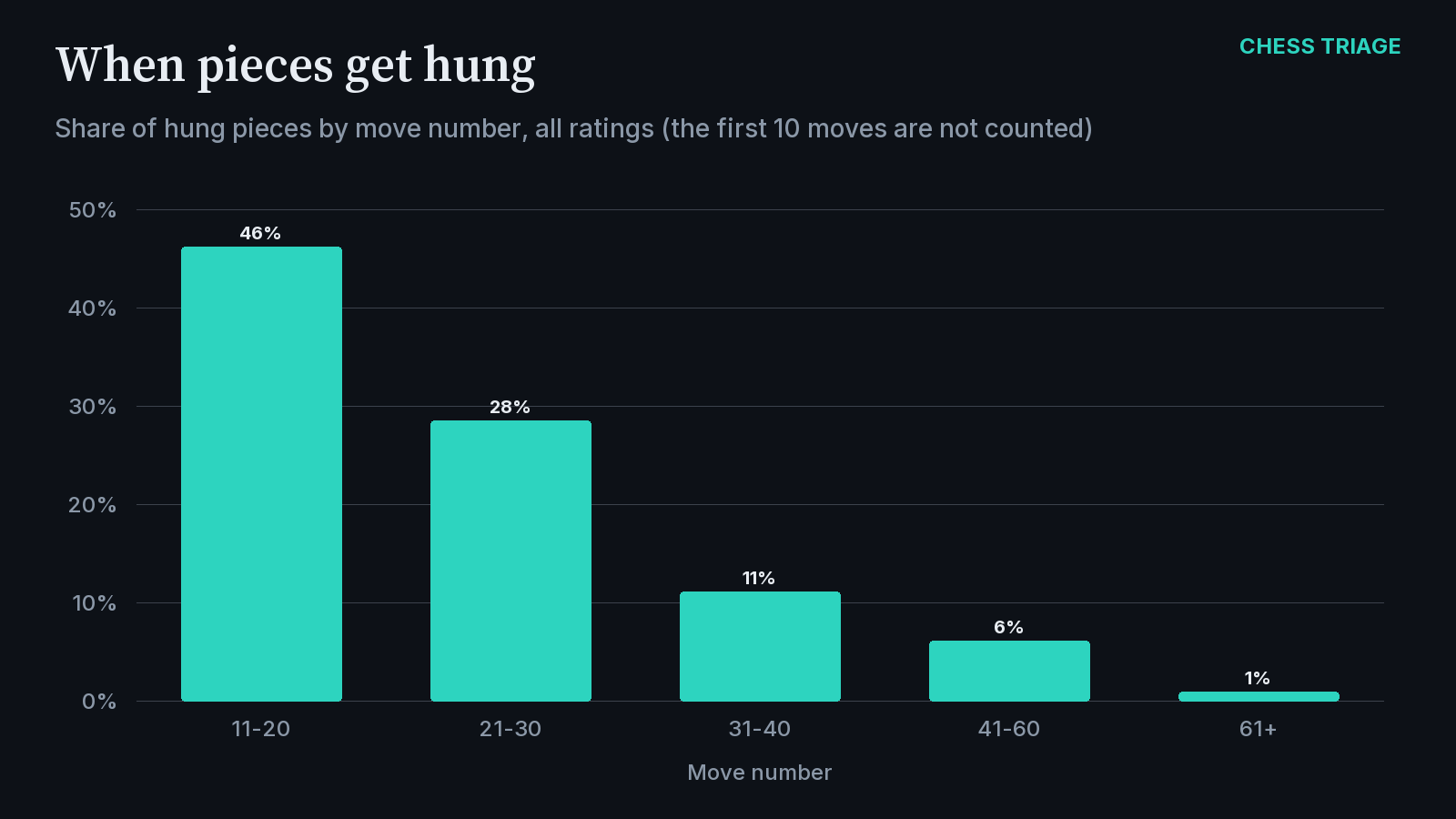
And not in the opening, or not mainly. Of the hung pieces after move 10, 46% came on moves 11 to 20 and 29% on 21 to 30: the middlegame (72% by phase), when every piece is out and the position is at its fullest. At 800 the share on moves 11 to 20 is 54%; at 2000 it is 30%, with more coming later as the games go on.
80% were taken on the very next move. That number matters for the fix: most hung pieces don't need the opponent to find anything. They need the opponent to look, and at every rating the opponent looks.
What it looks like
Three from players rated 400 to 700, and three from players rated 1800 and above. The move is the same mistake at both ends; what changes is how much else is going on around it.
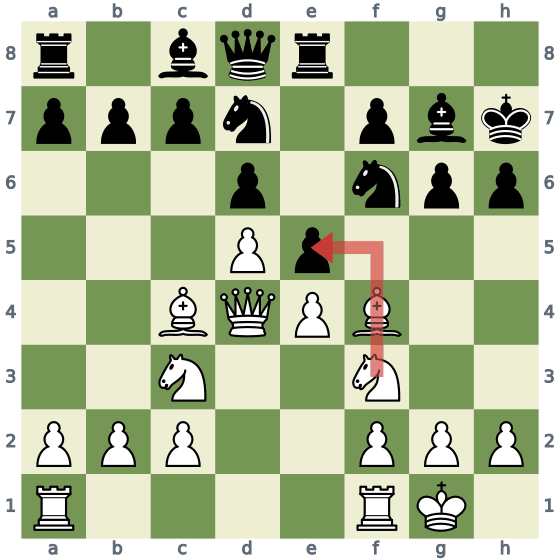
Rated 798 · Lichess Rapid 15+10 · move 11
White played 11.Nxe5, a blunder that left them losing. Find a better move.
Find the better move →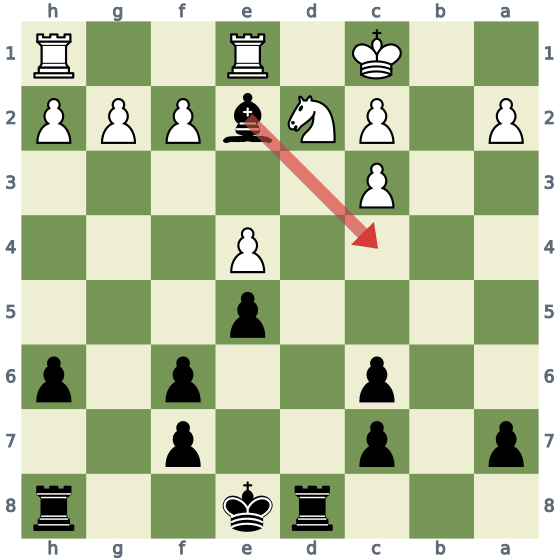
Rated 742 · Lichess Blitz 3+0 · move 14
Black played 14...Bc4, a blunder that left them losing. They went on to lose that game. Find a better move.
Find the better move →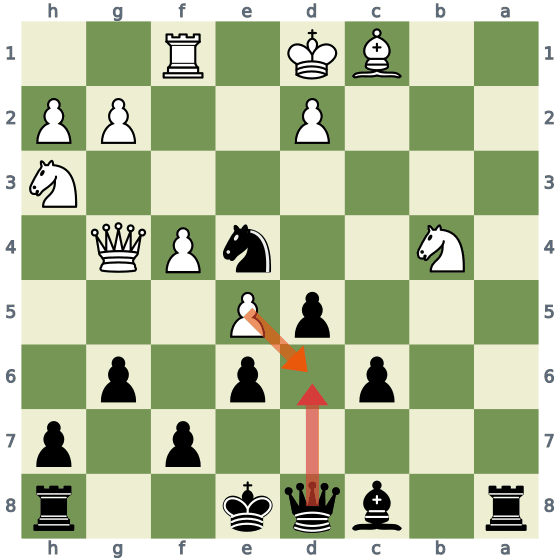
Rated 613 · Lichess Rapid 10+0 · move 21
Black played 21...Qd6 and left the queen to be taken: White answered exd6, and the win chance went from 89% to 17%.
Positions from the sampled games, shown from the player's side. The red arrow is the move played, the orange arrow the reply that punished it; a link opens the position on the board, where the site tells you whether you found the better move.
And at 1800 and above:
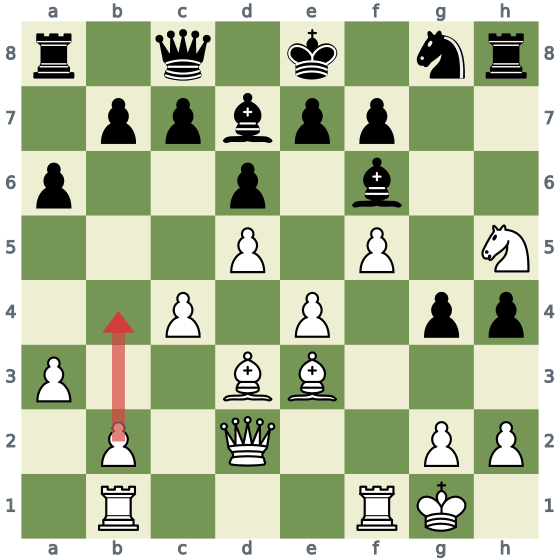
Rated 1934 · Lichess Blitz 3+0 · move 19
White played 19.b4, a blunder that turned a winning game into a losing one. Find a better move.
Find the better move →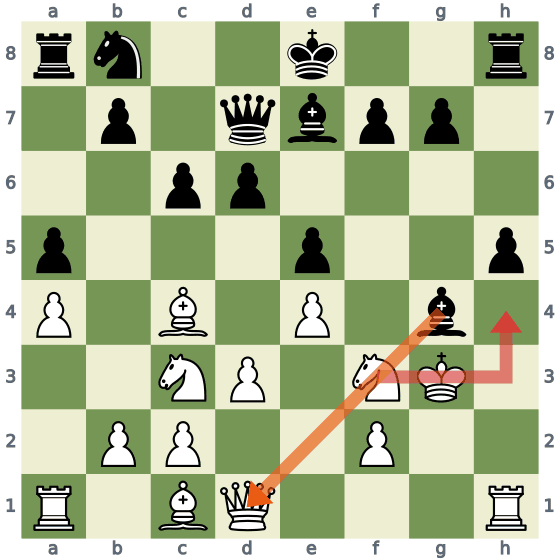
Rated 1802 · Lichess Rapid 10+5 · move 14
White played 14.Nh4 and left the queen to be taken: Black answered Bxd1, and the win chance went from 54% to 11%. White went on to lose.
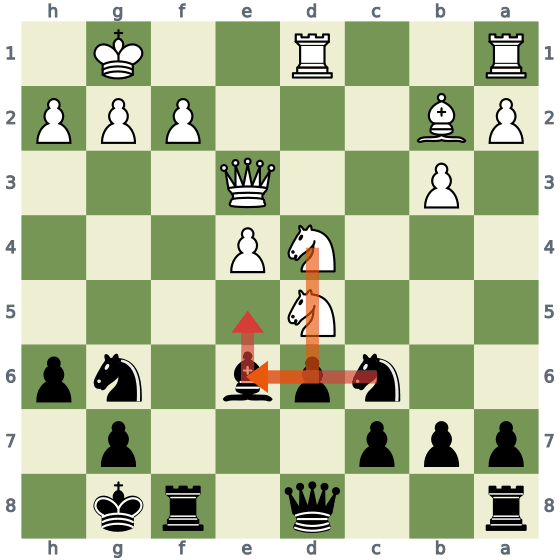
Rated 1905 · Lichess Rapid 10+0 · move 16
Black played 16...Nce5 and left the rook to be taken: White answered Nxe6, and the win chance went from 52% to 12%. Black went on to lose.
Positions from the sampled games, shown from the player's side. The red arrow is the move played, the orange arrow the reply that punished it; a link opens the position on the board, where the site tells you whether you found the better move.
The check that catches them
After you choose a move and before you play it: what can they take?
Two squares to look at. The square your piece is going to: which of their pieces attacks it, and is it defended enough? And the square your piece is leaving: what was it defending, and is that still defended? Then every capture they have anywhere on the board, because 80% of hung pieces were taken at once, which means the capture was already there to see.
That is the whole method, and the data says why it works. The pieces are hung with time on the clock, in the middlegame, and taken immediately. None of that is about calculation. It is about one habit: a last look at their captures after you've decided and before you've moved. Players who have the habit still hang pieces (the 2400s hang 0.24 a game), but at a quarter of the rate.
Two more, for the pieces that get hung most.
Rooks: before a rook goes to an open file or the seventh, name the minor piece that could reach that square in one move. Queens, below 1000: when the queen moves to attack, ask what attacks it back on the new square. A queen that can be hit with tempo is a queen that gets trapped.
What won't fix it on its own: playing slower. The share of hung pieces under 30 seconds is 10% overall, so a longer clock buys you a longer wait before the same move. Tactics puzzles help with the other half of the game, the win you didn't take; they don't drill the look at your own loose pieces, because a puzzle never asks you to.
How many do you hang?
The report counts every piece you left to be taken in your last 75 games on Chess.com or Lichess, which piece, how often, and whether you were winning at the time, and gives you the positions to solve on the board. One player's sample report: rooks 23 times, bishops 14. The number you get is the one habit to work on first. Free, no card, just your username.
Related: chess mistakes by rating · why you keep losing · Daily Blunder: hanging pieces · stuck at 800 · stuck at 1200.
Check your own games: free chess game analysis · free chess game review · chess blunder checker.
How it works
1. Give us a username
Chess.com or Lichess. No account to make, nothing to install.
2. We go through every move
Your last 75 games, looking for the moments that keep costing you.
3. See what they've been hiding
In your inbox in about 15 minutes, with the positions to solve on the board.
Questions
Why do I keep hanging pieces?
Because the look that catches it comes after the decision and before the move, and that is the step most players skip when they have a plan. The data says it isn't the clock (84% of hung pieces had over a minute left) and it isn't the opening (72% are in the middlegame). It is one missing habit, and it is the same one at every rating.
How often do chess players hang pieces?
In rated Lichess blitz and rapid, 0.5 times a game on average: 0.68 at 600, 0.57 at 1200, 0.39 at 2000, 0.24 at 2400 and above. It is 31% of all mistakes at 400 and 13% at 2400 and above.
Which piece gets hung most?
The queen at 400 (30% of hung pieces), usually the rook from 1200 up (26% at 1200, 27% at 1600). Across all ratings: rook 26%, queen 24%, knight 20%, bishop 16%, pawn 14%.
Is hanging pieces a time-pressure problem?
Mostly not. 10% of hung pieces were played with under 30 seconds left and 44% with more than three minutes. The exception is above 2200, where the games are long and the clock decides more of them.
Do puzzles stop you hanging pieces?
Puzzles train the other half: finding the tactic that's there for you. A puzzle never asks whether your own move is safe, which is the look that stops hung pieces. Positions from your own games do ask it, because the question is always what you should have played instead of the move that lost the piece.
Is it really free?
Yes. We're building a training tool around these reports and want honest feedback from real players. No card, no trial.
Do you need my password?
Never. Your games on Chess.com and Lichess are public; we read them through the sites' official APIs. We only need your username and an email to send the report to.
Find out how many you hang, and which.
Free report from your last 75 games on Chess.com or Lichess, in your inbox in about 15 minutes.
Get my free report